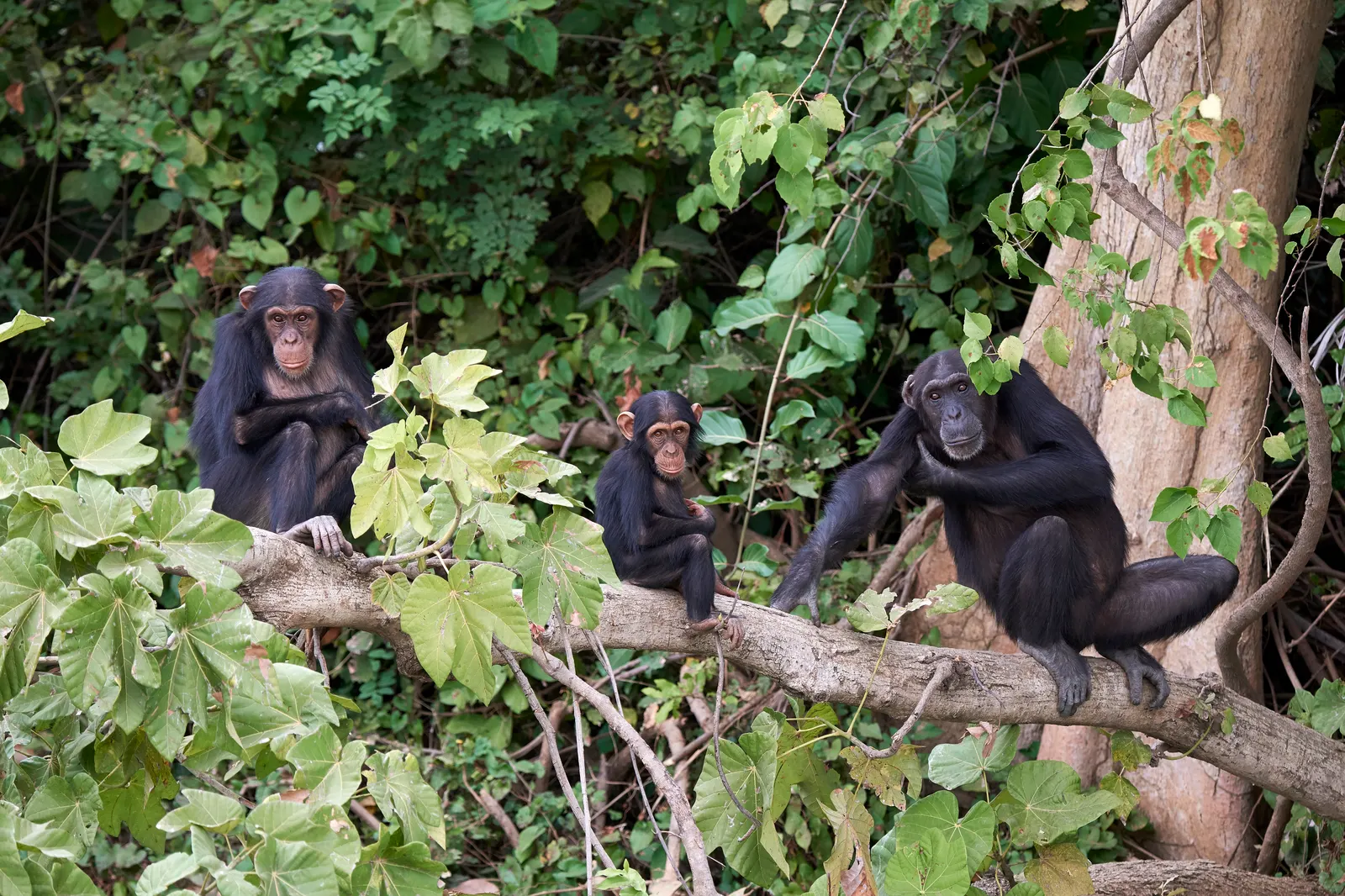
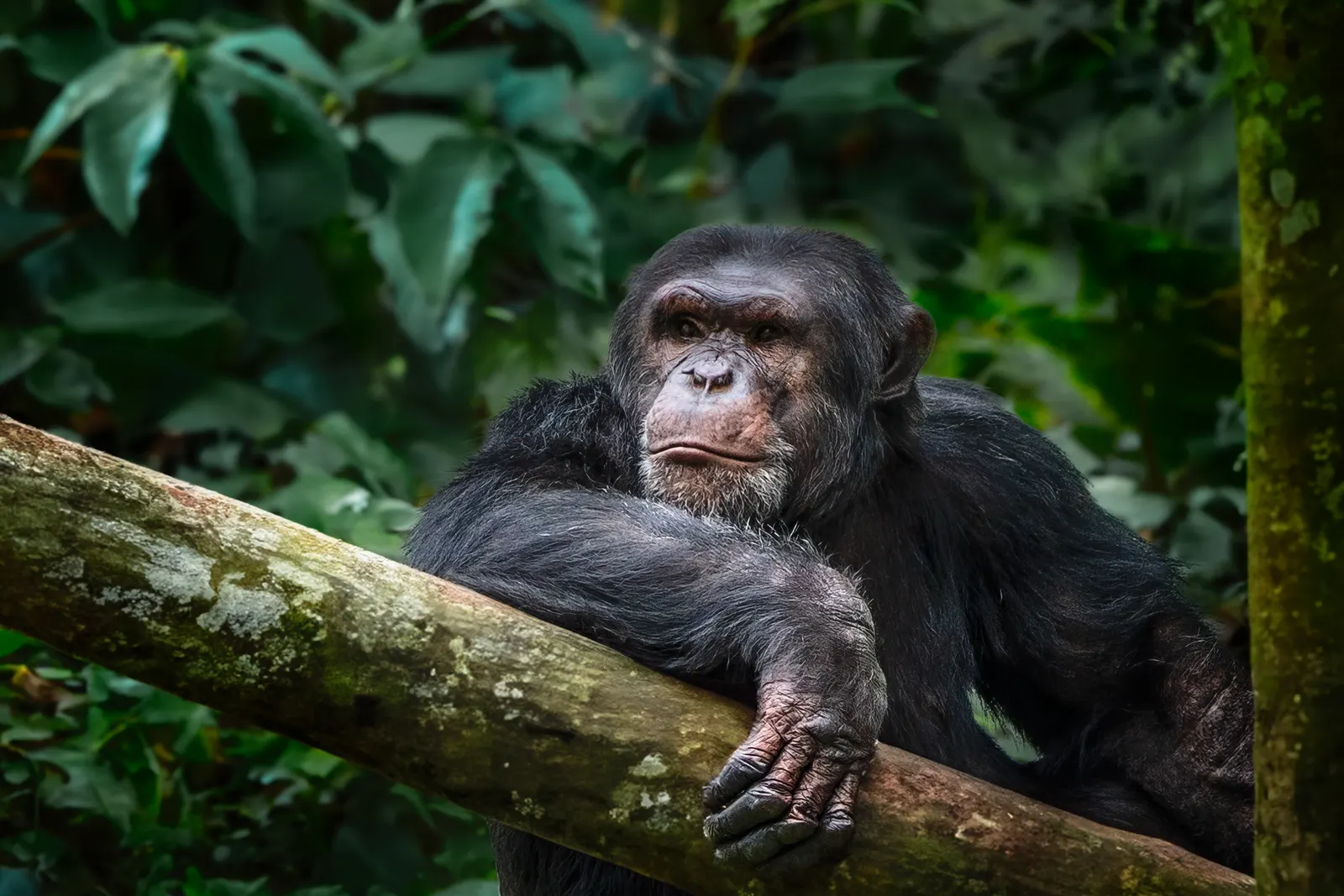
Mahale is one of two places in Tanzania to track wild chimpanzees on foot, and it is not the same experience as its smaller, better-known cousin. Mahale is a range of forested mountains dropping straight into Lake Tanganyika, reached by light aircraft and then a boat, with no roads inside the park at all. Everything from the airstrip onwards happens on foot or on the water.
What follows is what a Mahale trek actually involves — the journey in, the physical effort of the climb, the hour once the chimpanzees are found, and why the minimum age is set where it is. For how Mahale compares with Gombe, Tanzania’s other chimpanzee park, see the table below.
The short answer
A Mahale chimp trek starts with a light-aircraft flight and a boat, then a walk of twenty minutes to four hours to find the habituated Mimikire community, followed by a strict one-hour viewing limit. The minimum age is 12, three years lower than Gombe’s, because both the terrain and the animals demand it.
Mahale and Gombe, Tanzania’s two chimpanzee parks | Mahale | Gombe |
|---|
| Access | Light aircraft, then a boat | A short boat ride from Kigoma |
|---|
| Research began | 1965, Kyoto University | 1960, Jane Goodall |
|---|
| Habituated community | Mimikire, about 60 chimpanzees | Kasekela, a similar size |
|---|
| Typical trek | 20 minutes to 4 hours | Often under 2 hours |
|---|
| Minimum age | 12 | 15 |
|---|
| Viewing time once found | One hour | One hour |
|---|
| More | Mahale guide | Gombe guide |
|---|
Getting there
Mahale has no road connection to the rest of Tanzania. Access is by scheduled light aircraft from Arusha or Dar es Salaam to an airstrip near the park, followed by a boat transfer of one to two hours along the Lake Tanganyika shore to reach camp. The whole journey takes most of a day, and because flights run on fixed days rather than daily, an itinerary has to be built around the schedule rather than the other way round.
That remoteness is most of why Mahale costs what it does and why relatively few travellers make the trip, compared with the northern circuit parks a short drive from Arusha. Camps here range from around $450 a person a night at simple community-run bandas to well over $2,000 at the most exclusive beachfront camp, before flights, and there is little in between — Mahale does not really have a budget option once the flight is added in. It is also why the forest stays as intact as it does: there is no road network to support day-trippers, and every visitor arrives by the same slow route.
Katavi National Park, also in the remote west, is the natural add-on, linked by the same weekly flight circuit; some itineraries fly back via Dar es Salaam instead, for the southern parks or Zanzibar. Either way, budget the travel days themselves as part of the trip rather than dead time either side of it — with flights running on fixed days rather than daily, a Mahale trip is usually a week or more, not a quick add-on to a northern-circuit safari.
The climb
This is not a game drive. Trackers set out ahead at first light to find the Mimikire community — Mahale’s habituated group, around sixty chimpanzees studied continuously since 1965 — and radio back their position once they do, working from a knowledge of the community’s ranging habits built up over decades rather than from any fixed route. Guests then follow on foot, and the walk to reach them can run anywhere from twenty minutes to four hours, depending entirely on where the chimps happened to move overnight.
The trails are steep, humid and often slippery, with no formal path underfoot — this is forest, not a maintained route — and reasonable fitness matters more here than on most safari activities. A stick helps on the descents. Proper walking shoes are not optional, and neither is being honest with your guide beforehand about what you can manage.
Fit guests who want more can add a two-day climb to the 2,462-metre summit of Mount Nkungwe, through montane forest and bamboo, arranged separately from chimp trekking and unrelated to it. Most visitors do not attempt both on the same trip; the chimp trek alone is enough of a physical day for most people.
The hour with them
Once the group is found, viewing time is limited to one hour by park regulation, and the clock starts when you arrive, not when you get a clear view. Chimpanzees share around 98% of human DNA and are vulnerable to human respiratory illness, so the rules exist to protect them as much as you: a distance of roughly seven metres is expected, and anyone with a cold or flu should not trek that day.
What that hour actually looks like depends entirely on what the community is doing — grooming, resting in the canopy, moving between feeding trees, or, occasionally, nothing very dramatic at all. Wild chimpanzees do not perform for an audience, and a guide who oversells the encounter beforehand is setting you up to be disappointed by animals behaving normally.
The dry season, from around May to October, is when the odds are best — the Mimikire community tends to stay lower on the slopes and treks run shorter, with a success rate commonly put at around 90%. In the wet season the chimps range higher with no guaranteed sighting at all, which is why our
Mahale journey is built around those drier months.
Why the age limit exists
Mahale sets a minimum age of 12 for chimpanzee trekking, three years lower than Gombe’s 15. Both limits are set by the park authorities, not by individual camps, and neither is negotiable regardless of how fit or keen a younger child might be.
Two things sit behind the age limit. The trek itself is physically demanding in a way most safari activities are not, on ground that offers no easy way to turn back partway through once a group is committed to reaching the chimps. And wild chimpanzees, unlike the animals watched from a vehicle on a game drive, are unpredictable at close range — an adult male can move fast and behave aggressively without warning, and the rules assume everyone present can understand an instruction and follow it immediately, in a language they may not share with the guide giving it.
For families travelling with younger children,
Gombe is not actually the easier option, since its age limit is higher still. A trip built around
Tarangire or the northern circuit, with a chimp trek added for the adults only, tends to work better for mixed-age families than either chimpanzee park on its own.
Questions people ask
How difficult is chimpanzee trekking at Mahale?
Moderately demanding. Trails are steep, humid and often without a formal path, and treks run from twenty minutes to four hours depending on where the chimps moved overnight. Reasonable fitness and proper walking shoes matter more here than on most safari activities.
What is the minimum age for chimp trekking at Mahale?
Twelve, set by the park authorities and not negotiable. It is three years lower than Gombe’s minimum age of 15, though the trek itself is longer and more physically demanding than Gombe’s.
How does Mahale compare to Gombe for chimp trekking?
Mahale is far more remote, reached by light aircraft and boat rather than a short boat ride from Kigoma, with longer and less predictable treks. Gombe is smaller, easier to reach, has a higher minimum age, and is where Jane Goodall’s research began in 1960.
How do I get to Mahale Mountains National Park?
By scheduled light aircraft from Arusha or Dar es Salaam to an airstrip near the park, then a boat transfer of one to two hours along the Lake Tanganyika shore. Flights run on fixed days, so the whole journey takes most of a day and has to be built into the itinerary.
Are chimpanzee sightings guaranteed at Mahale?
No sighting of a wild animal is guaranteed, but the dry-season success rate is commonly put at around 90%, when the Mimikire community stays lower on the slopes. In the wet season the chimps range higher and treks take longer with less certainty.
How long can I spend with the chimpanzees once I find them?
One hour, by park regulation, starting from when you arrive rather than when you get a clear view. The limit exists to protect the chimpanzees from stress and disease as much as to manage visitor numbers.
When is the best time to visit Mahale?
May to October, the dry season, when chimps range lower and trails are easier. Most camps close between March and April for the long rains; October to December is a greener, quieter alternative with fewer guests.
What else is there to do at Mahale besides chimp trekking?
Swimming and snorkelling in Lake Tanganyika, which is bilharzia-free along the Mahale shore and holds more than 250 species of endemic cichlid fish, plus an optional two-day climb to the 2,462-metre summit of Mount Nkungwe for fit guests.
Travel it
Journeys built around this
Last updated 13 September 2026