Most Zanzibar itineraries treat Stone Town as the fifteen minutes between the airport and the transfer van to the beach. That undersells a town UNESCO listed as a World Heritage Site in 2000 for a genuinely rare mix of Swahili, Arab, Persian, Indian and European building styles, packed into a small peninsula of narrow, largely car-free lanes.
This is what a proper stop here actually covers: the old town itself, the site that carries the heaviest history, the market that comes alive after dark, and what to wear and how to get here. One landmark below is currently closed, and we say so plainly rather than writing around it.
The short answer
Stone Town rewards a proper stop, not a fifteen-minute transfer. Give it half a day: the carved-door old town and the Old Fort in daylight, Christ Church Cathedral on the former slave market site, and Forodhani Gardens’ night food market before you move on to the beach. The House of Wonders has been closed for restoration since 2020.
Why stop here: a UNESCO town, not a beach transfer
Stone Town earned its UNESCO listing in 2000 for architecture that exists almost nowhere else in this combination: coral-stone buildings, carved wooden doors, wide verandas and inner courtyards built by Swahili, Arab, Persian, Indian and European traders and rulers over several centuries, layered onto one another rather than replacing what came before. The whole old town sits on a small peninsula, most of it closed to cars.
A guided walk through the core sites takes three to four hours, which is enough for a genuine half-day stop rather than a corridor you pass through on the way somewhere else. Arriving a day ahead of the beach leg, or building in one night here before moving on, turns Stone Town into a destination in its own right rather than a layover between an airport and a resort.
The old town: doors, alleys and two centuries-old landmarks
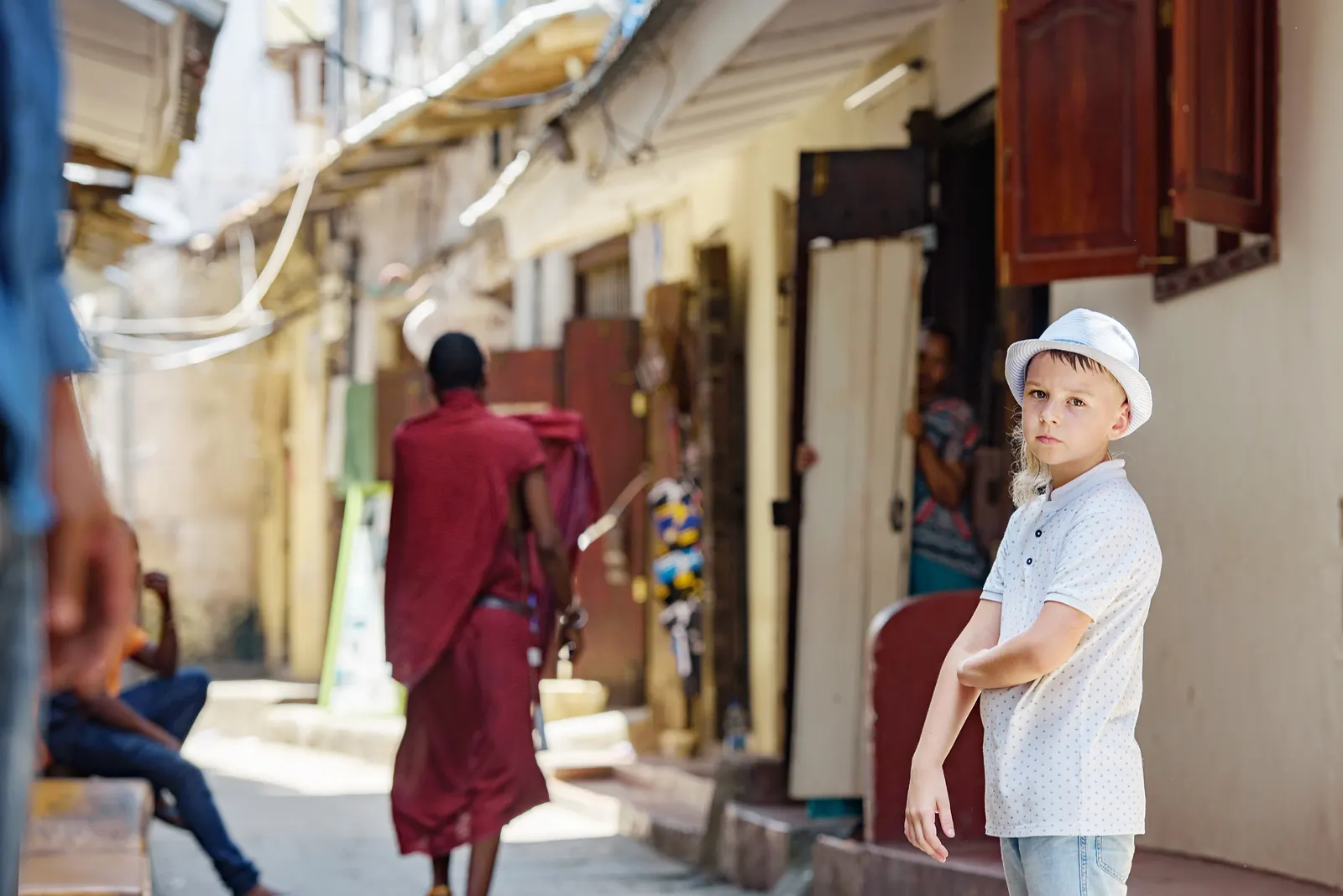
The carved wooden doors on many older houses are worth stopping for rather than photographing in passing — Arab-style doors with brass studs (historically meant to deter charging elephants, a detail more decorative than practical by the time most surviving doors were carved) and geometric patterns, and Indian-style doors with more floral detail, a genuine local craft tradition rather than decoration added for visitors.
The Old Fort, built by Omani Arabs around 1699-1700 on the site of an earlier Portuguese chapel, is the oldest surviving structure of its kind in the old town. It now works as a cultural centre — a coral-stone courtyard used for markets, craft stalls and occasional evening performances rather than a roped-off ruin, and one of the easier stops to combine with a walk along the seafront.
The House of Wonders, completed in 1883 and once the tallest building in East Africa, is the landmark most guidebooks still describe as open. It is not: part of the structure collapsed in December 2020, it has been closed since, and restoration work funded in part by Oman is ongoing with no confirmed public reopening date at the time of writing. Treat it as an exterior landmark for now — worth seeing from the seafront for the building itself — and check current status before planning a visit inside it.
The slave trade: what the cathedral remembers
Christ Church Cathedral was built between 1873 and 1879 on the site of Zanzibar’s former slave market, one of the last operating in East Africa before abolition, when tens of thousands of people passed through the town each year. It was built deliberately on that ground, to mark the end of the trade rather than to erase where it happened.
The altar is reported to stand on the site once used to whip people before they were sold, and the chambers beneath the church, once used to hold enslaved people awaiting sale, can still be visited. A memorial sculpture of chained figures stands outside. Neither detail is softened for visitors, and it should not be.
This is a heavy site, and it is worth the thirty to forty-five minutes it takes to see properly, with a guide who can explain what you are looking at and answer questions honestly, rather than a five-minute stop wedged between two other landmarks on a group tour that treats it as one more photograph.
Forodhani Gardens: the market after dark
Forodhani Gardens is a waterfront park that turns into an open-air food market from early evening: grilled seafood and skewers, Zanzibari pizza (a stuffed, fried flatbread rather than anything Italian), fresh sugarcane juice, and dozens of stalls lit by lanterns as the sky over the harbour goes dark and the House of Wonders’ silhouette rises behind the crowd.
It is busy, informal and cheap compared with a restaurant meal, and it makes a useful contrast to a day spent in the old town’s heavier history — loud, sociable, and entirely present-tense. Stick to the stalls with the fastest turnover and the longest queues of local customers, and agree a price before you order rather than after.
It also makes a natural end to a Stone Town day, close to several of the old-town sites already on your route, before an early night ahead of an early flight or ferry the next morning to wherever the rest of the trip takes you next.
Getting here: dress, ferries and flights
Modest dress is the general expectation in the old town, which is majority Muslim — shoulders and knees covered, more so than on the beach a short drive away. This is a matter of local custom rather than law, and carrying a light scarf covers you for a quieter street, a mosque exterior or the cathedral without changing your whole outfit for the day.
Most visitors reach Stone Town by short domestic flight from the northern safari circuit’s own airstrips, roughly an hour or so depending on the route and subject to the usual 15kg soft-bag limit on light aircraft rather than a normal airline allowance. A fast ferry from Dar es Salaam is the other common route, under two hours on the quicker services.
Either way, Stone Town sits at the start of the coast leg of a trip rather than somewhere you have to detour for. Our
Joining Zanzibar journey is built around exactly that — the old town, a spice farm and the east-coast beaches on one shared route, on scheduled transfers rather than a private vehicle for the whole leg.
Questions people ask
Is Stone Town worth visiting before the beach?
Yes, if you give it half a day rather than a drive-through. It is a UNESCO World Heritage old town with genuine history, not just a stop between the airport and a beach transfer, and it sits at the start of most routes to the coast anyway.
Is the House of Wonders open in 2026?
No. Part of the building collapsed in December 2020 and it has been closed since. Restoration work is under way, funded partly by Oman, but there is no confirmed public reopening date — check current status before planning around it, and treat it as an exterior landmark for now.
What should you wear in Stone Town?
Shoulders and knees covered is the general expectation in the old town, which is majority Muslim, more so than on the beach itself a short drive away. Carrying a light scarf covers you for a mosque or a quieter street without changing your whole outfit.
How long do you need in Stone Town?
A guided walk through the core sites takes three to four hours. Add the Forodhani Gardens night market and a proper visit to Christ Church Cathedral and half a day, or an overnight, is a better fit than a rushed morning.
Is Forodhani Gardens safe at night?
It is busy, lit and full of families and other visitors most evenings, which is generally reassuring, though the usual city-centre sense applies: stick to the busy stalls, keep valuables close, and eat where the turnover is fast.
How do you get to Stone Town from the safari circuit or the mainland?
By short domestic flight from the northern circuit’s airstrips, roughly an hour or so depending on the route, or by fast ferry from Dar es Salaam, under two hours on the quicker services.
What is the significance of Christ Church Cathedral?
It was built between 1873 and 1879 on the site of Zanzibar’s former slave market, one of the last operating in the region. The altar marks the site reportedly used to whip enslaved people for sale, and the chambers below can still be visited.
Is Stone Town worth it with only one day in Zanzibar?
It is worth a morning even on a single day, but it will use most of it properly done. If the beach is the only priority and time is that tight, a shorter, guided two-hour version of the old town is more realistic than the full walk.
Travel it
Journeys built around this
Last updated 13 September 2026