Places of Africa Safaris

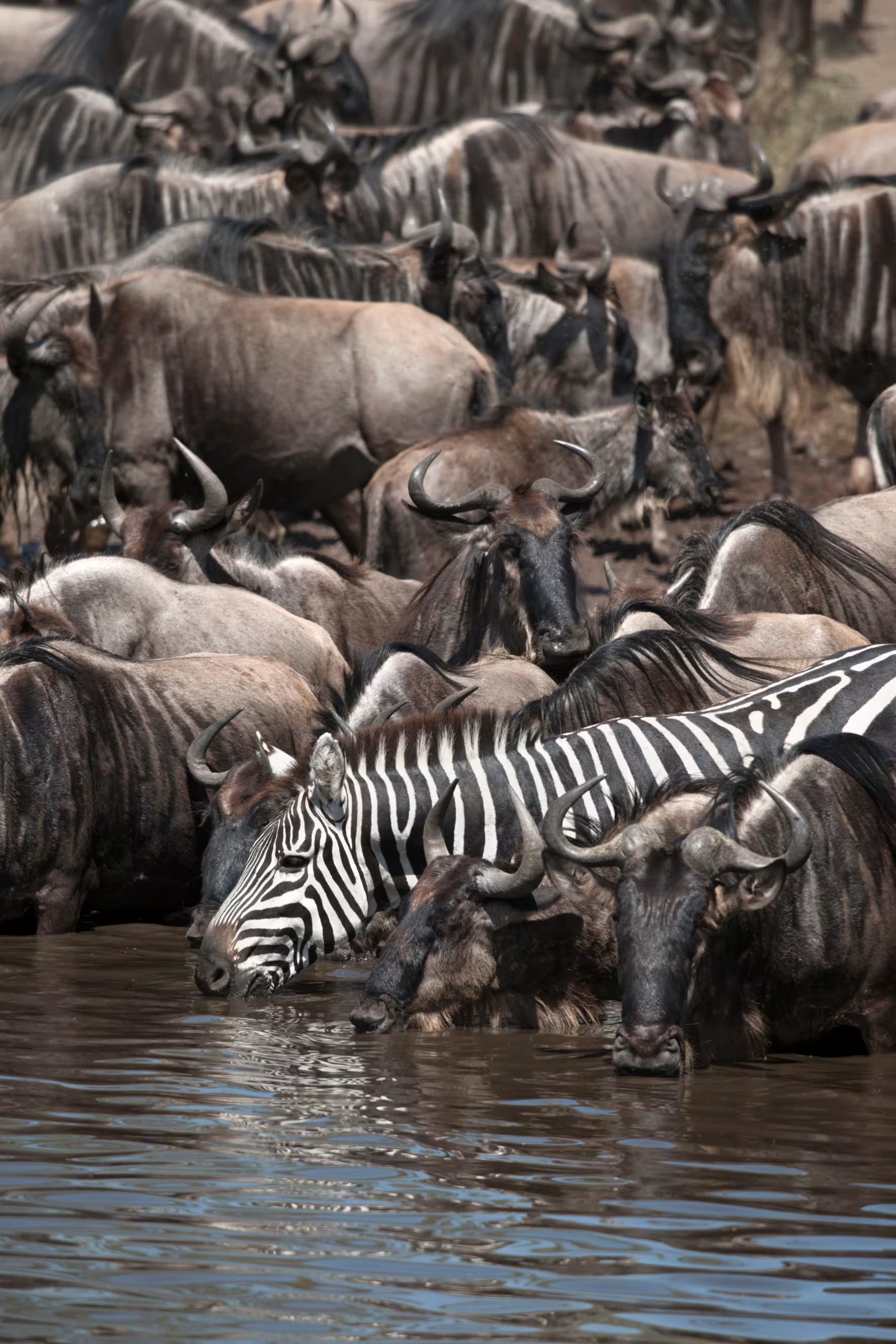
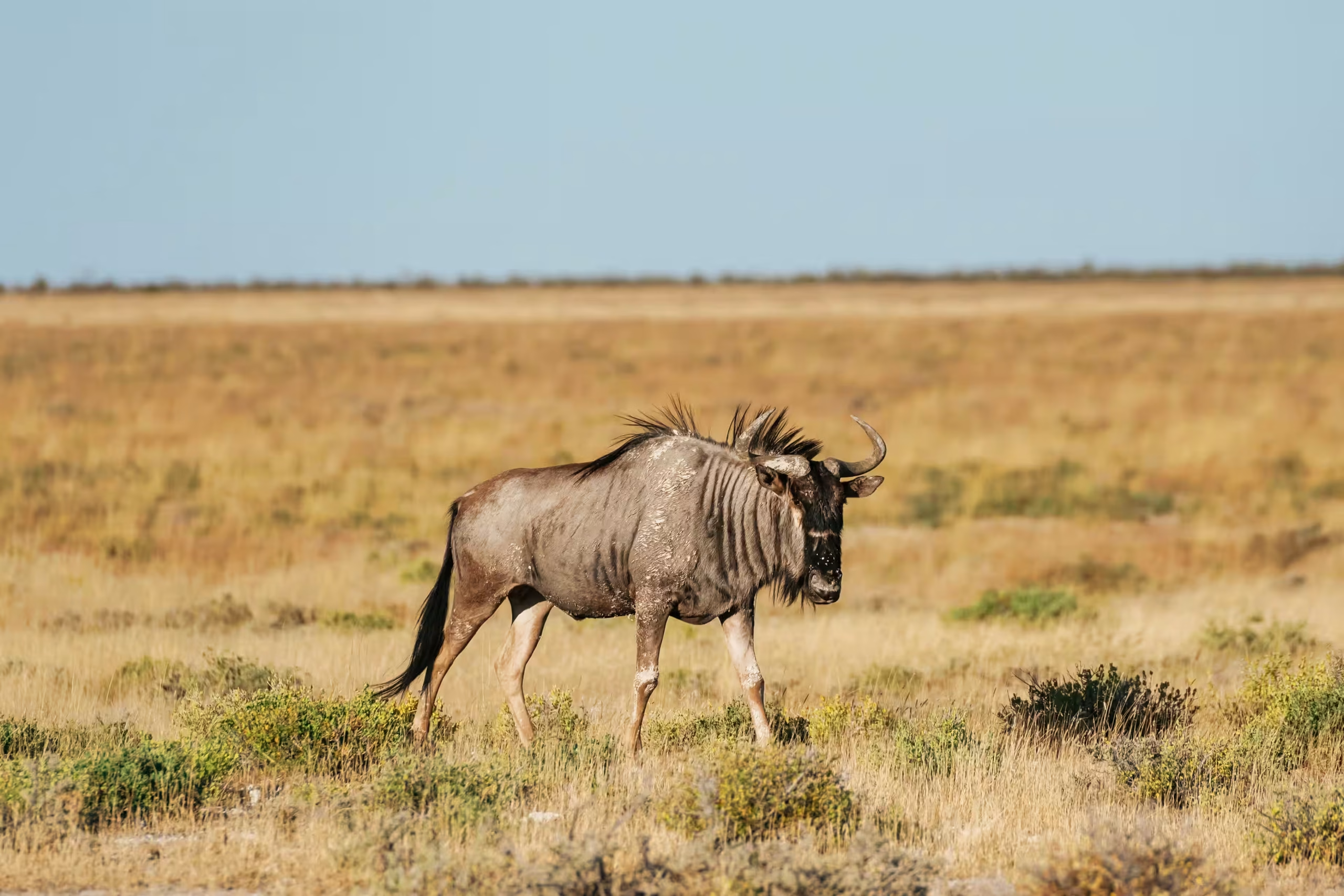
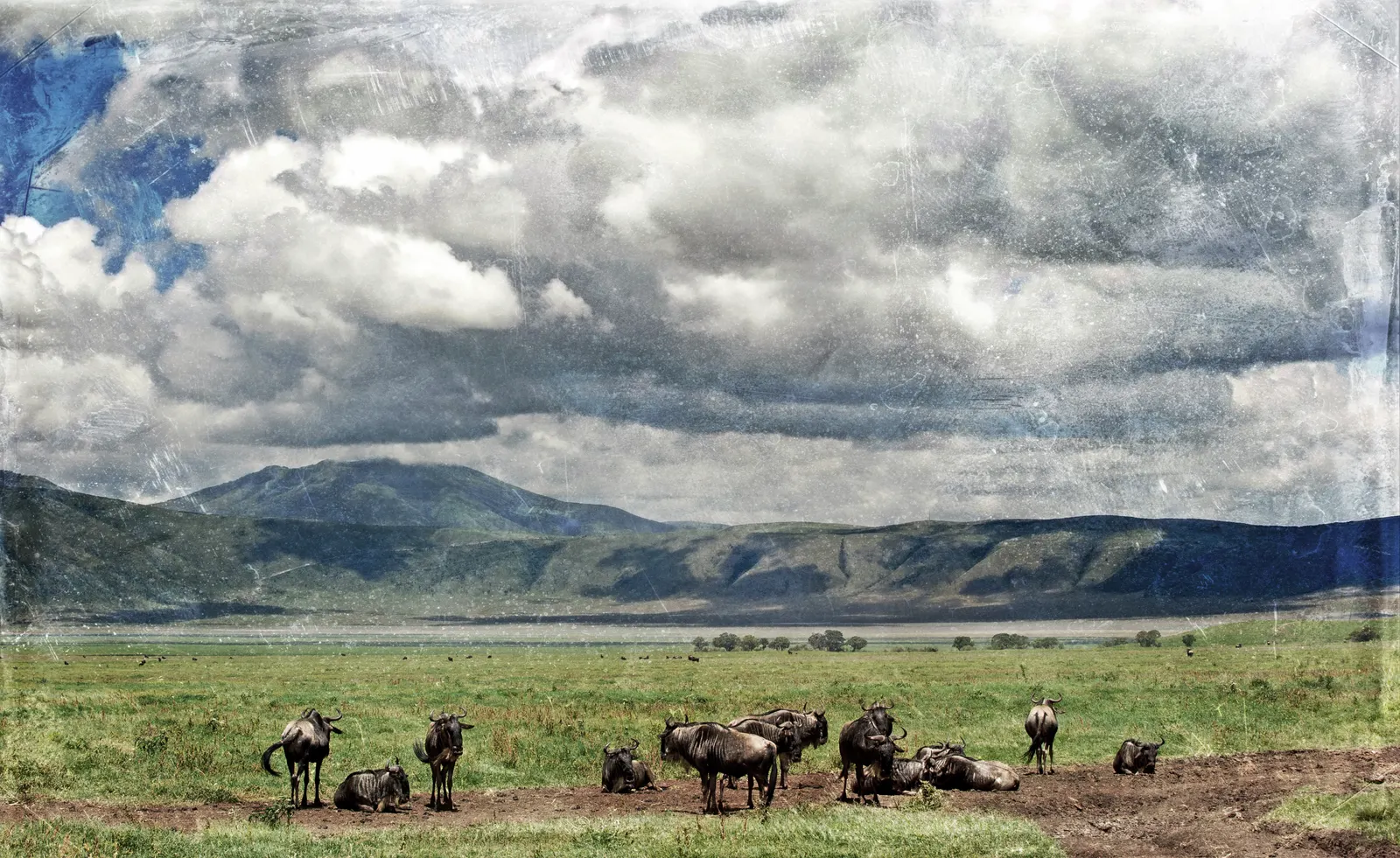
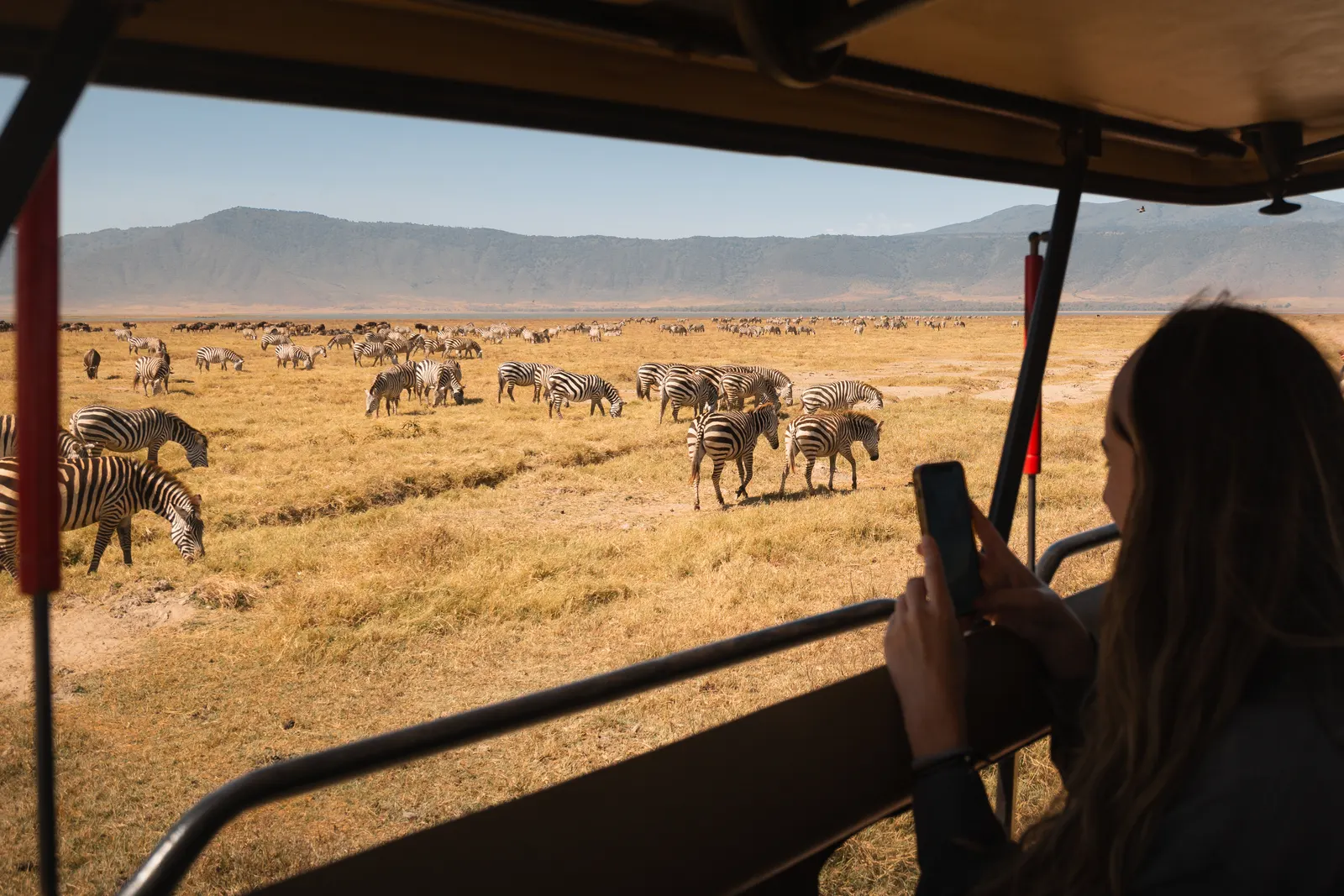
Wildebeest in the Ngorongoro Crater
Northern Circuit · Six Days

Ngorongoro, and the Crater Highlands

The crater floor at first light, the highlands above it on foot with a ranger, and Lake Manyara on the way — six days that do the Ngorongoro properly instead of driving through it.
6
Days
5
Nights
2
Parks
2,300 m
Rim
I · Overview

The route, and why this shape

Two parks on one road out of Arusha, and a loop back. One road day, not three.
Most safaris give the Ngorongoro Crater one morning on the way to somewhere else. Six hours on the floor, then the road to the Serengeti. This trip does the opposite: it makes the crater and the highlands around it the whole point, and it does not go to the Serengeti at all. That is a deliberate trade, and it suits a fixed week, a first safari with children, or anyone who would rather walk one day than drive six.
The shape is a loop out of Arusha and back. Lake Manyara first, on the way up the Rift wall — ninety minutes of groundwater forest and hippo pool that costs nothing in time. Then two nights on the crater rim at 2,300 metres. One morning is the floor from the moment the descent road opens, before the day vehicles arrive from Karatu. The other day is the highlands above the rim on foot, at Olmoti or Empakaai with a ranger, and a Maasai boma inside the conservation area.
The honest trade is this: no plains, no migration, no leopard in a sausage tree. What you get instead is the rhino at first light with the floor still under cloud, a walk to a crater lake almost nobody reaches, and a trip with one road day rather than three.
Length
6 days / 5 nights
Country
Tanzania
Start / end
Arusha → Arusha
Tour type
Private safari
Group size
Private — 1 to 6 guests per vehicle
Meal plan
Full board on safari, bed and breakfast in Arusha
Best months
June – October, and January – February
Activity level
Easy to moderate — one ranger-led walk of 1–3 hours
Vehicle
Toyota Land Cruiser 4×4 with a pop-up roof, a window seat for every guest, charging points and a cool box
II · The days

Day by day, all six

Every day opens. Two nights on the Ngorongoro rim; the floor at first light, the highlands on foot. See every lodge and camp we use
Day
01
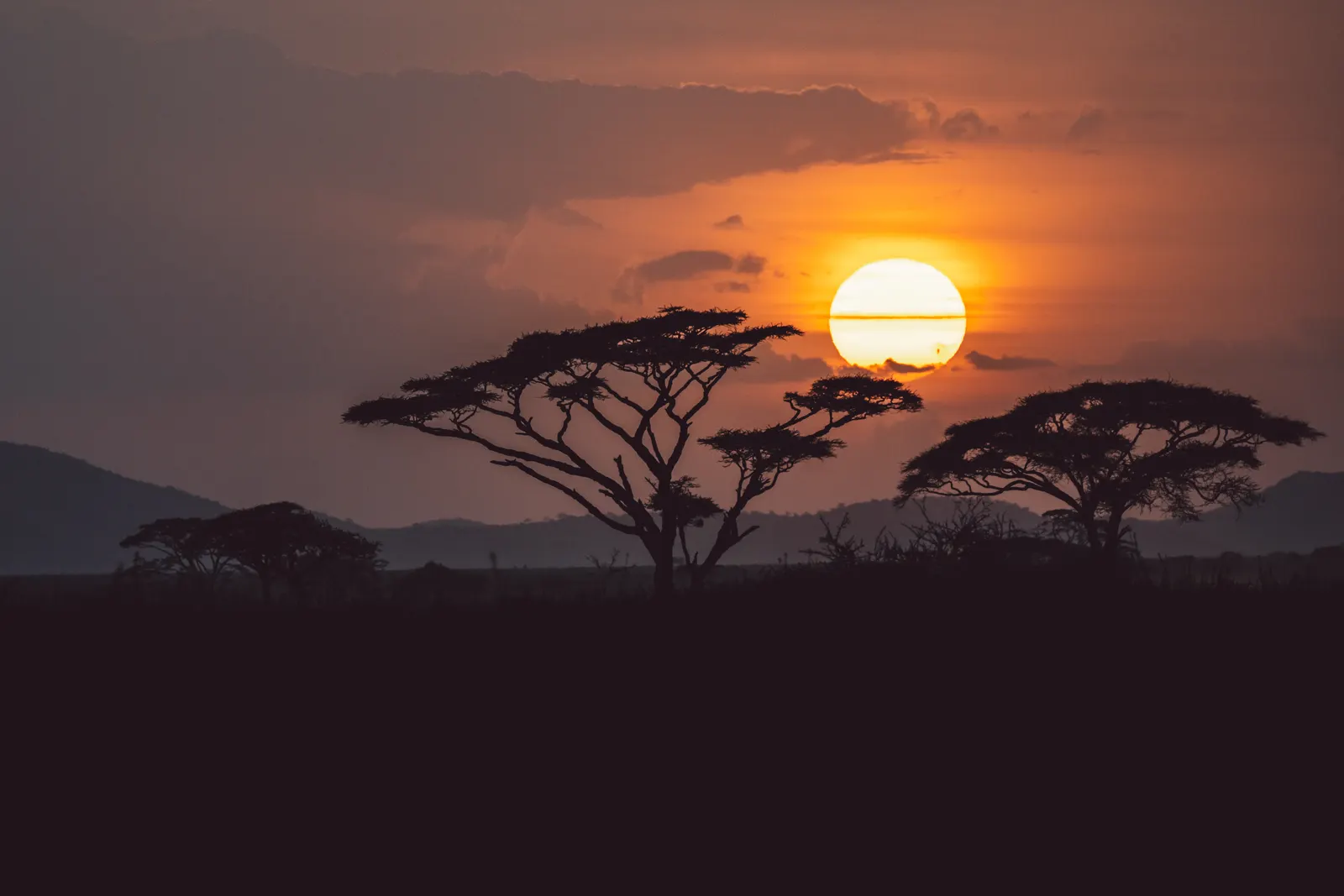
Acacia trees silhouetted against the setting sun
Arrival

Landing, and a night in Arusha

03°22′S 36°41′E
Dinner
Acacia trees silhouetted against the setting sun
Landing, and a night in Arusha
03°22′S 36°41′E
You land at Kilimanjaro International, fifty kilometres east of Arusha and about an hour by road. Your guide meets you at the door. The drive in runs through coffee shambas and under the southern slopes of Mount Meru, which you will see if you land in daylight and will not if, like most long-haul arrivals, you land after five.
Nothing is scheduled tonight. Arusha sits at 1,400 metres and the first evening always feels longer than it is. Eat early, repack into a soft bag — hard cases do not fit under the bench seats of a safari vehicle — and sleep. On a six-day trip the temptation is to push on to Karatu tonight and buy a morning. Resist it: the last hour of that road would be in the dark and you would arrive too tired to use it.
Do one piece of admin before bed rather than on the road. Agree the tipping arrangement with your guide and change money for it. It removes the only awkward conversation of the week, and it leaves tomorrow morning free for the drive west. Your guide will run through the six days over dinner if you want it, or leave you alone if you do not.
Meals
Dinner
Travel
Kilimanjaro International to Arusha · 50 km · about 1 hr
Highlight
No game drive today, on purpose
Meet at Kilimanjaro International
Arusha, 1,400 m
No game drive today
Where you sleep
Kahawa House: Two-storey main building with terrace and swimming pool in the gardens
COMFORT

Kahawa House

★★★★☆
Arusha, garden suburbs
A quiet garden lodge on the edge of town, bed and breakfast, close enough to the road west for a prompt start.
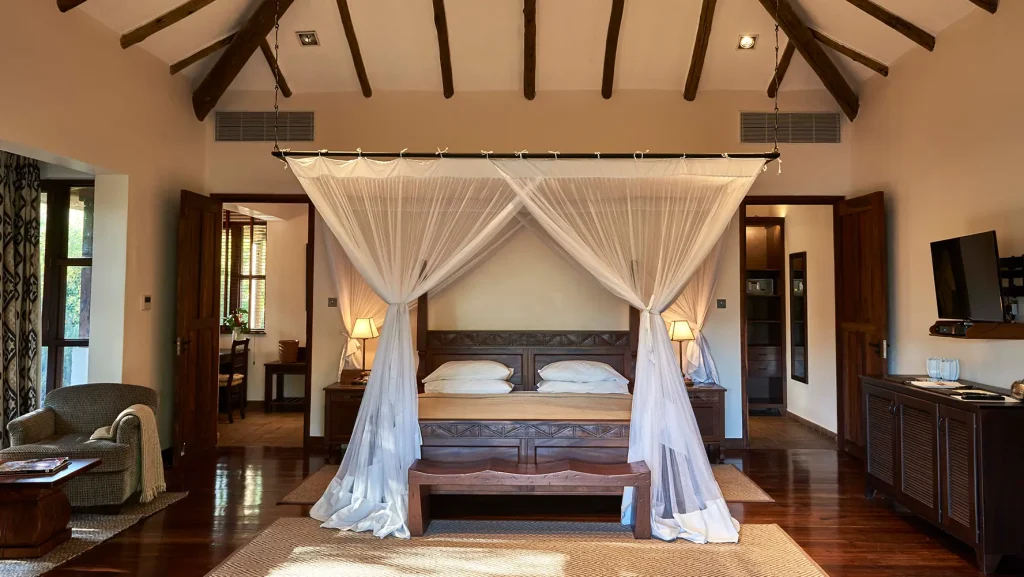
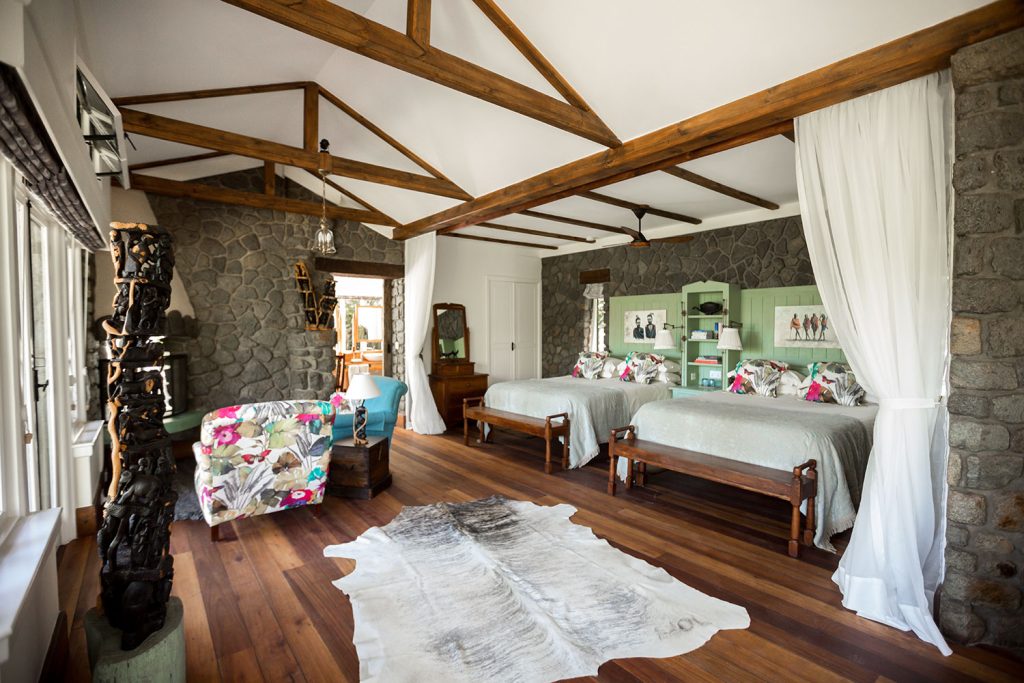
Legendary Lodge: Bedroom with wooden four-poster bed and white sheer curtains, hardwood floors
LUXURY

Legendary Lodge

★★★★★
Arusha, coffee estate
A room on a working coffee estate outside town, with a proper dinner and the first real quiet since the aircraft.
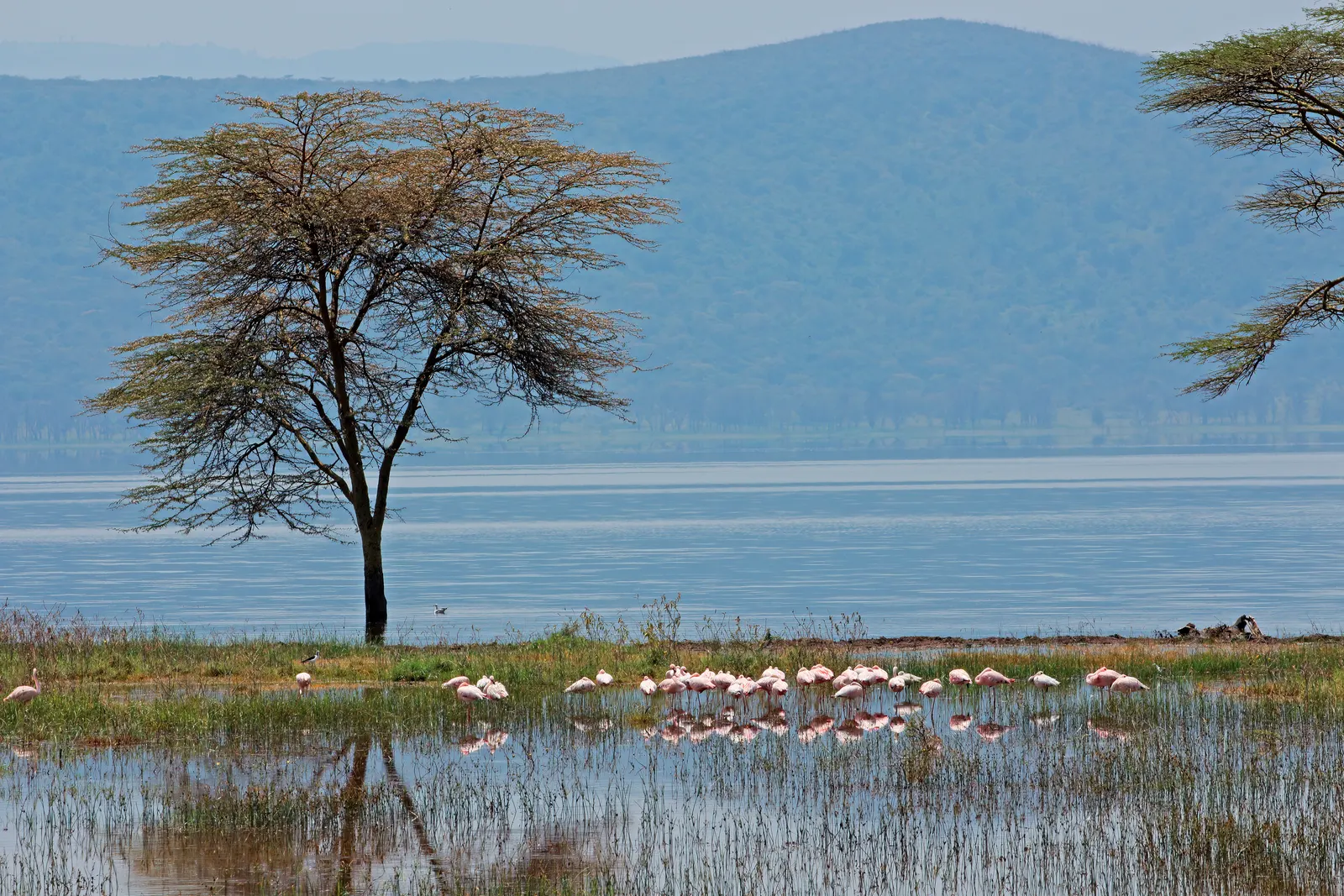
Flamingos in the shallows below an acacia by a lake
The groundwater forest, then up the Rift wall
03°23′S 35°49′E
West out of Arusha after breakfast, two hours on tarmac across Maasai grazing land to the foot of the Rift wall. Lake Manyara is a narrow park pressed between the escarpment and the lake — 330 square kilometres, two-thirds of it water — and the road enters under closed groundwater forest fed by springs at the base of the cliff. Fig and mahogany, blue monkeys overhead, and baboon troops on the track that are among the largest anywhere.
The forest opens onto floodplain and the soda flats. Flamingo numbers depend entirely on water level, so they are not promised — some months there are thousands, some months none. The hippo pool at the northern end is reliable, and so are the elephant, which move between forest and lakeshore through the day. The tree-climbing lions are the park’s marketing; do not build the day around them.
Mid-afternoon the road climbs the escarpment in a series of bends, with the lake below you on the left the whole way up. There is a viewpoint at the top where everyone stops, and it is worth stopping. Karatu is farming country in the highlands, noticeably cooler than the Rift floor. Bring something warm out of your bag tonight.
Meals
Breakfast · Lunch · Dinner
Travel
Arusha to Manyara gate · about 120 km · 2 hrs on tarmac
Highlight
Forest, hippo pool and the soda lake below the escarpment
Groundwater forest
Hippo pool
Rift escarpment viewpoint
Where you sleep
Tloma Lodge: Swimming pool with umbrellas and loungers, lodge buildings and coffee farm behind
COMFORT

Tloma Lodge

★★★★☆
Karatu, among the coffee farms
A farm lodge in the highlands outside Karatu, en-suite, full board, fifteen kilometres from the conservation area gate.
Gibb's Farm: Farm cottage bedroom with twin beds, stone wall, eucalyptus floors and hand-crafted furniture
LUXURY

Gibb's Farm

★★★★★
Karatu, highland estate
A larger estate property with gardens, fires lit in the evening, and a kitchen that works from its own vegetable plot.
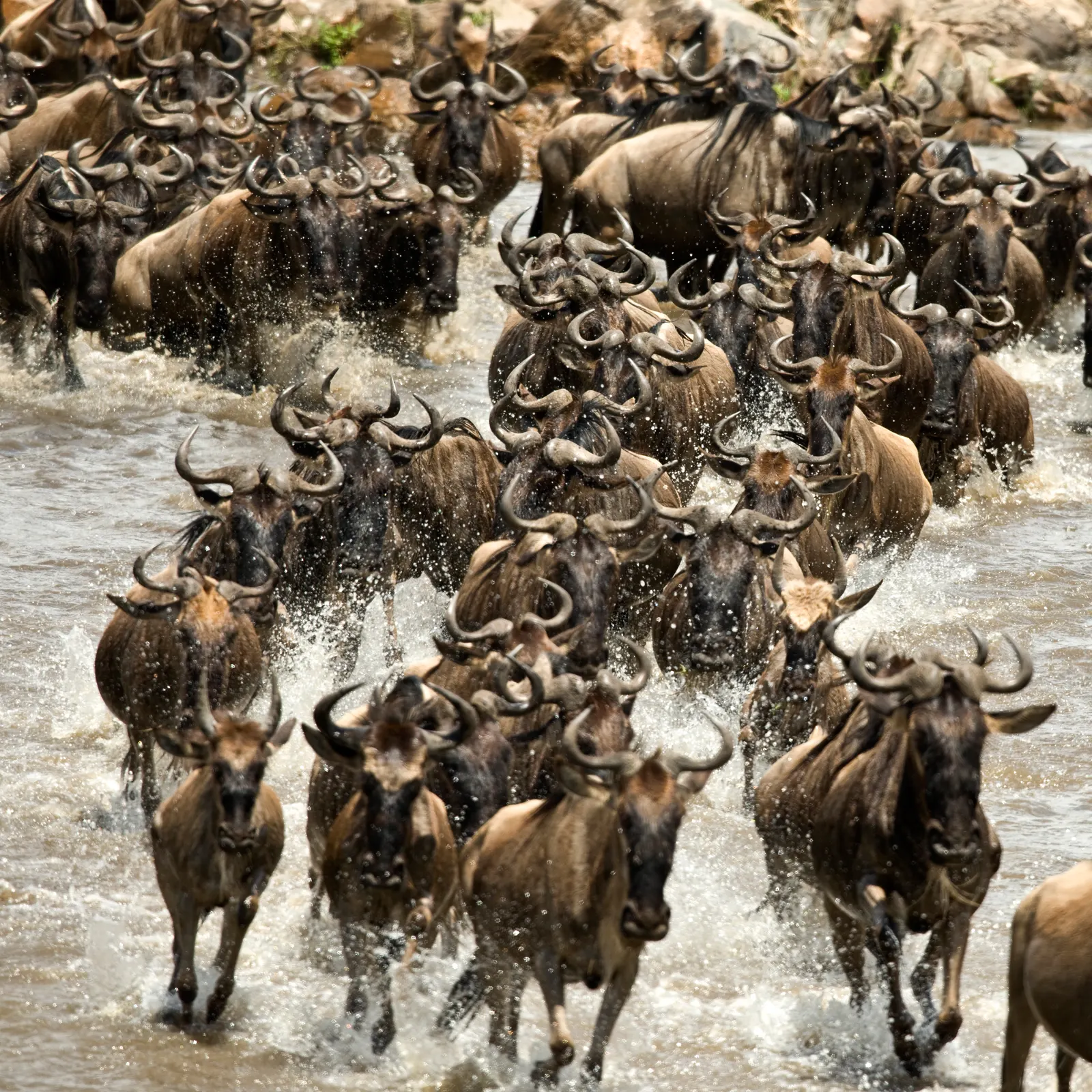
Wildebeest in the Ngorongoro Crater
Up to the rim, and a walk with a ranger
03°02′S 35°38′E
Fifteen kilometres from Karatu to the Lodoare gate, then the climb through montane forest to the rim at 2,300 metres. Most itineraries arrive here in the afternoon and descend the next morning, and that is the whole of their Ngorongoro. This one gives the highlands a day of their own, which is why there are two nights on the rim.
The Ngorongoro Conservation Area is the one protected area on the circuit where you can leave the vehicle. With an armed ranger you walk from the Nainokanoka ranger post up through the forest to the rim of Olmoti, a shallow grassy crater where the Munge stream leaves through a gap in the wall as a waterfall — about an hour up, less down. The alternative is Empakaai, further east and a longer drive on rough track: a steep descent through forest to a soda lake filling the crater floor, flamingo on it in most months, and on a clear day Ol Doinyo Lengai to the north-east. Empakaai is the better walk and the longer day; your guide will read the weather and your legs.
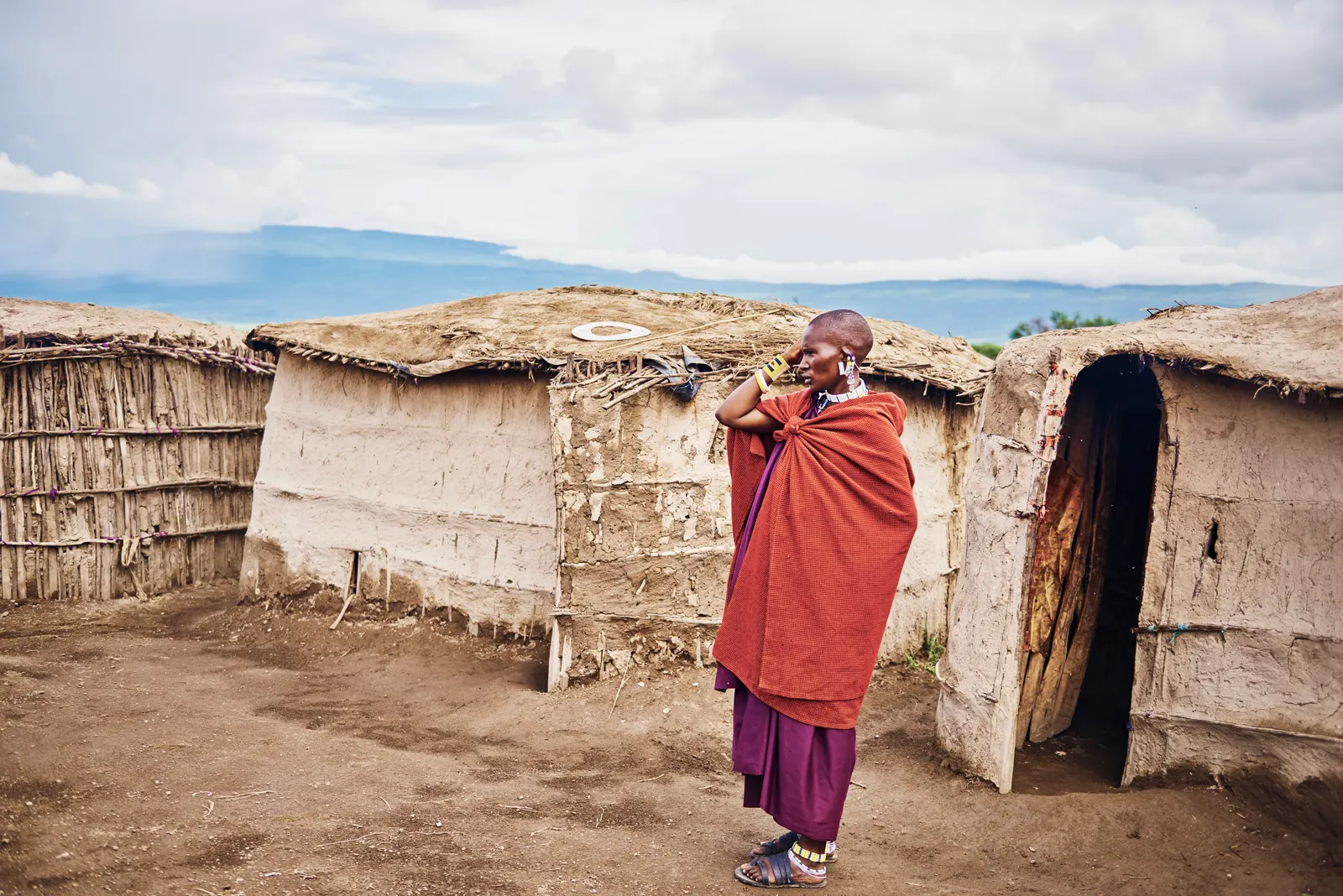
The Maasai live inside the conservation area by right, and a visit to a boma near Nainokanoka is arranged with the household, with the payment going to them. It is not a performance. Back on the rim for the temperature to drop — it is properly cold here after dark.
Meals
Breakfast · Lunch · Dinner
Travel
Karatu to the rim · about 30 km · then about 1 hour on to Olmoti, 2½ hours to Empakaai
Highlight
Olmoti or Empakaai on foot, and a Maasai boma inside the NCA
Ranger-led walk
Maasai boma, NCA highlands
Crater rim, 2,300 m
Where you sleep
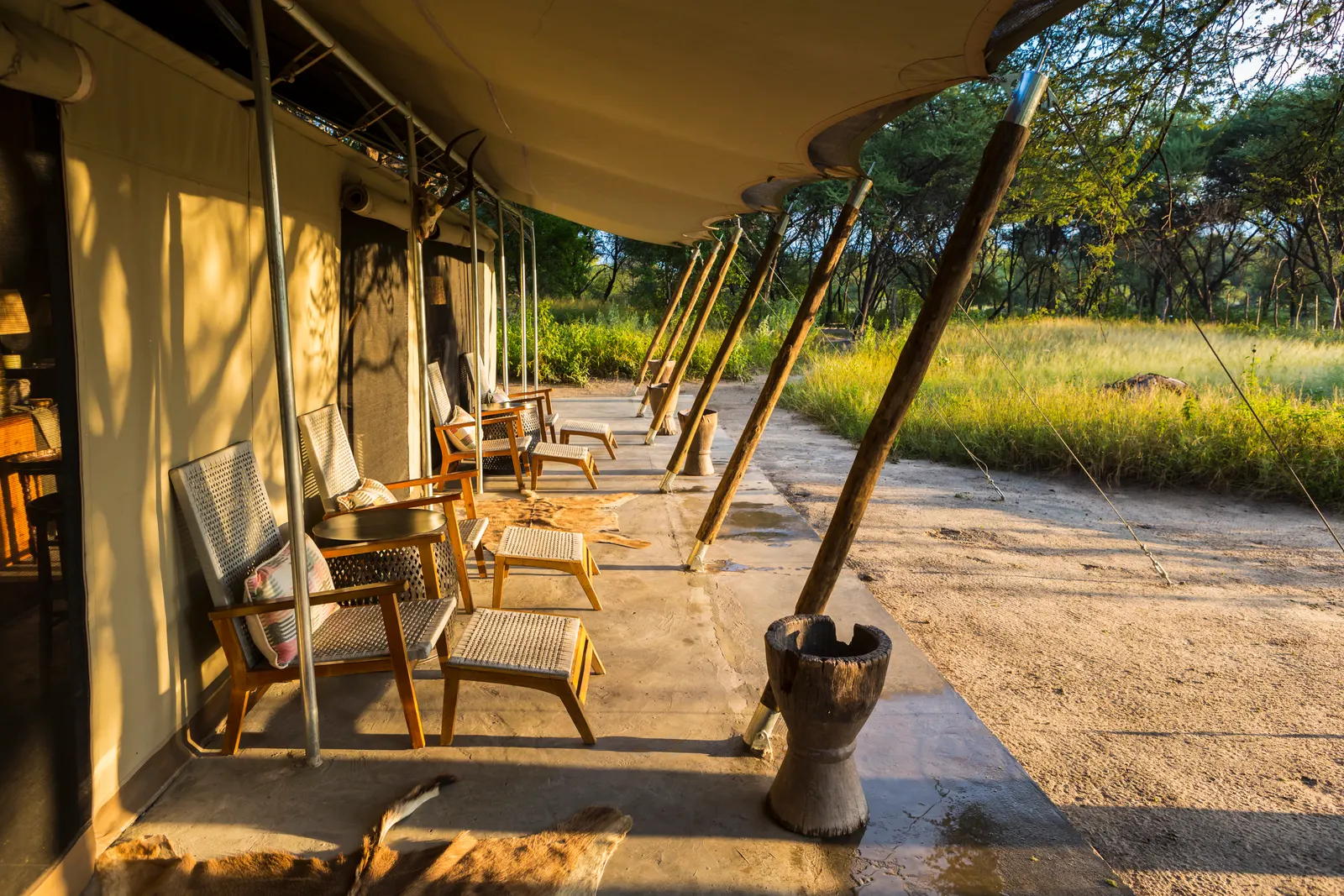
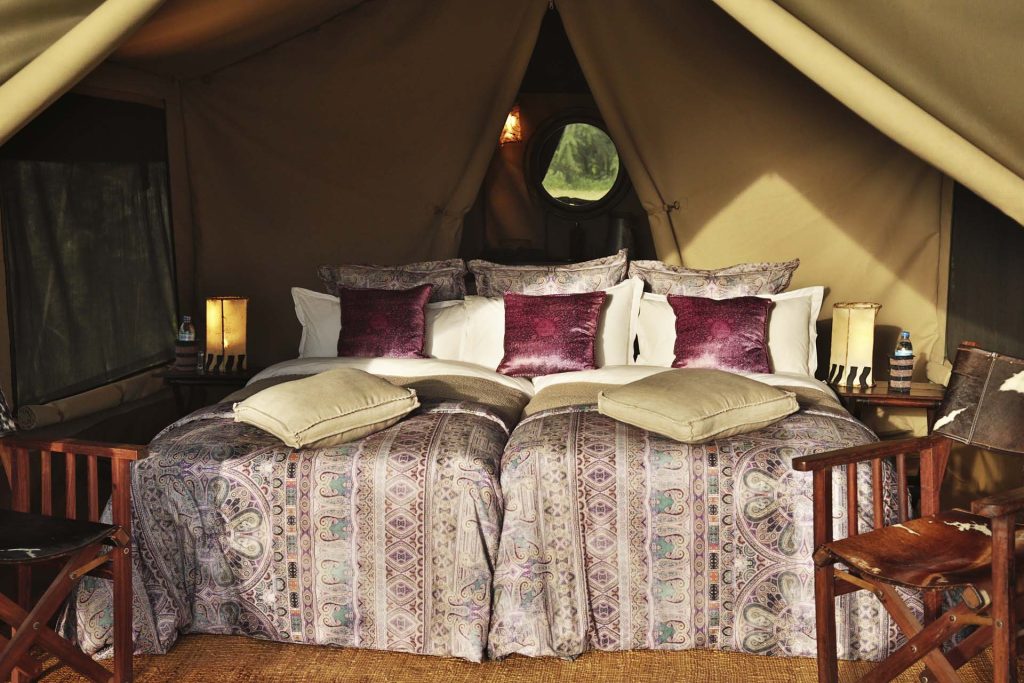
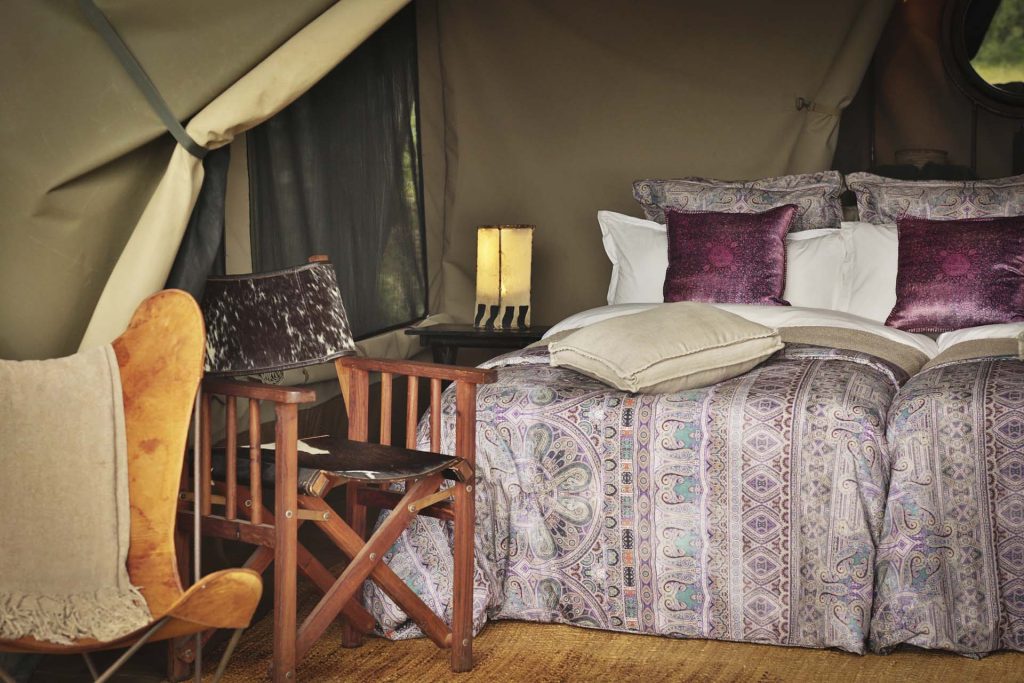
Pakulala Safari Camp: Tent interior with two queen beds, patterned throws and bedside lanterns
COMFORT

Pakulala Safari Camp

★★★★☆
Ngorongoro Conservation Area, rim
On the rim itself, which puts you at the descent road at dawn tomorrow rather than an hour behind the vehicles from Karatu.
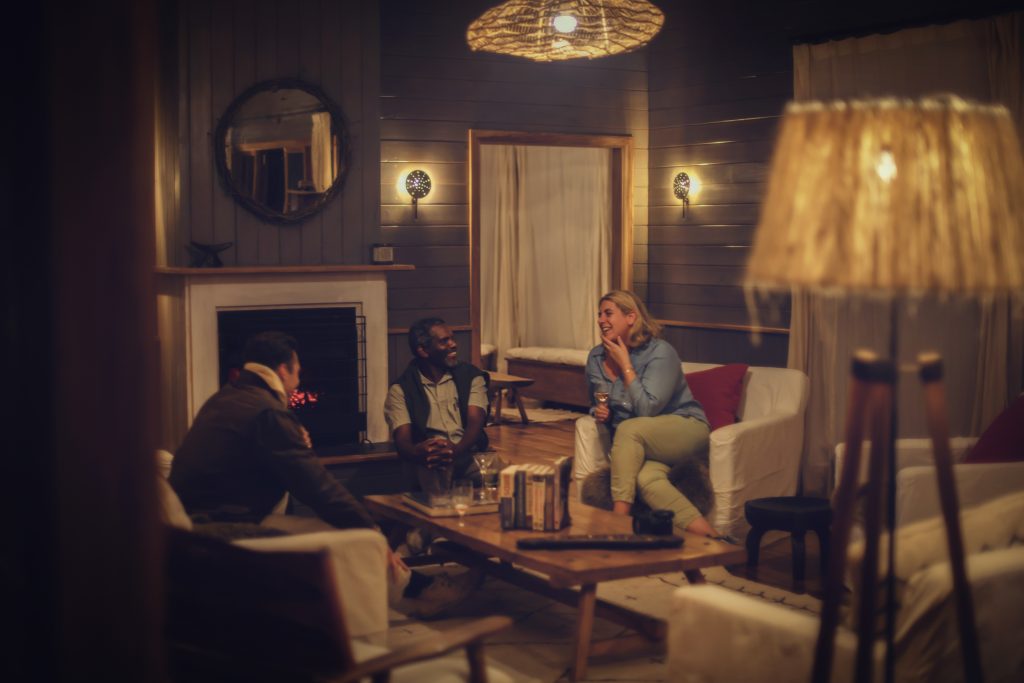
Entamanu Ngorongoro: Main lounge: guests by the fireplace
LUXURY

Entamanu Ngorongoro

★★★★★
Ngorongoro Conservation Area, rim
Rim-facing rooms with the crater floor below the window, fires lit in the evening, and blankets you will use.
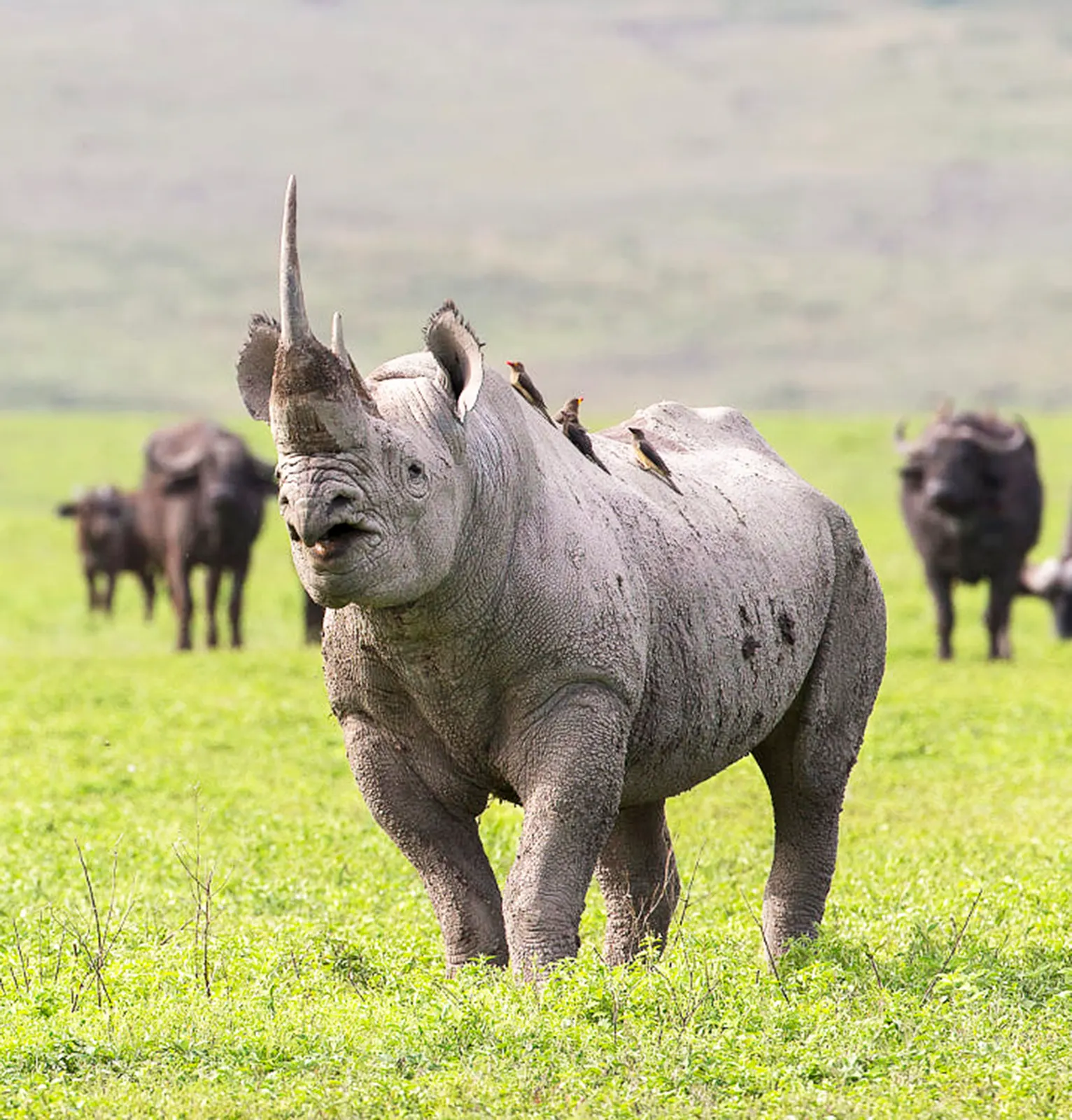
A black rhino with buffalo on green grass
The crater floor at first light
03°10′S 35°35′E
You leave before it is light. The descent road opens at six and you want to be on it, because the first hour on the floor, before the cloud lifts and before the day vehicles arrive up from Karatu, is the best game viewing of the week. Breakfast is in a box. It is worth the indignity.
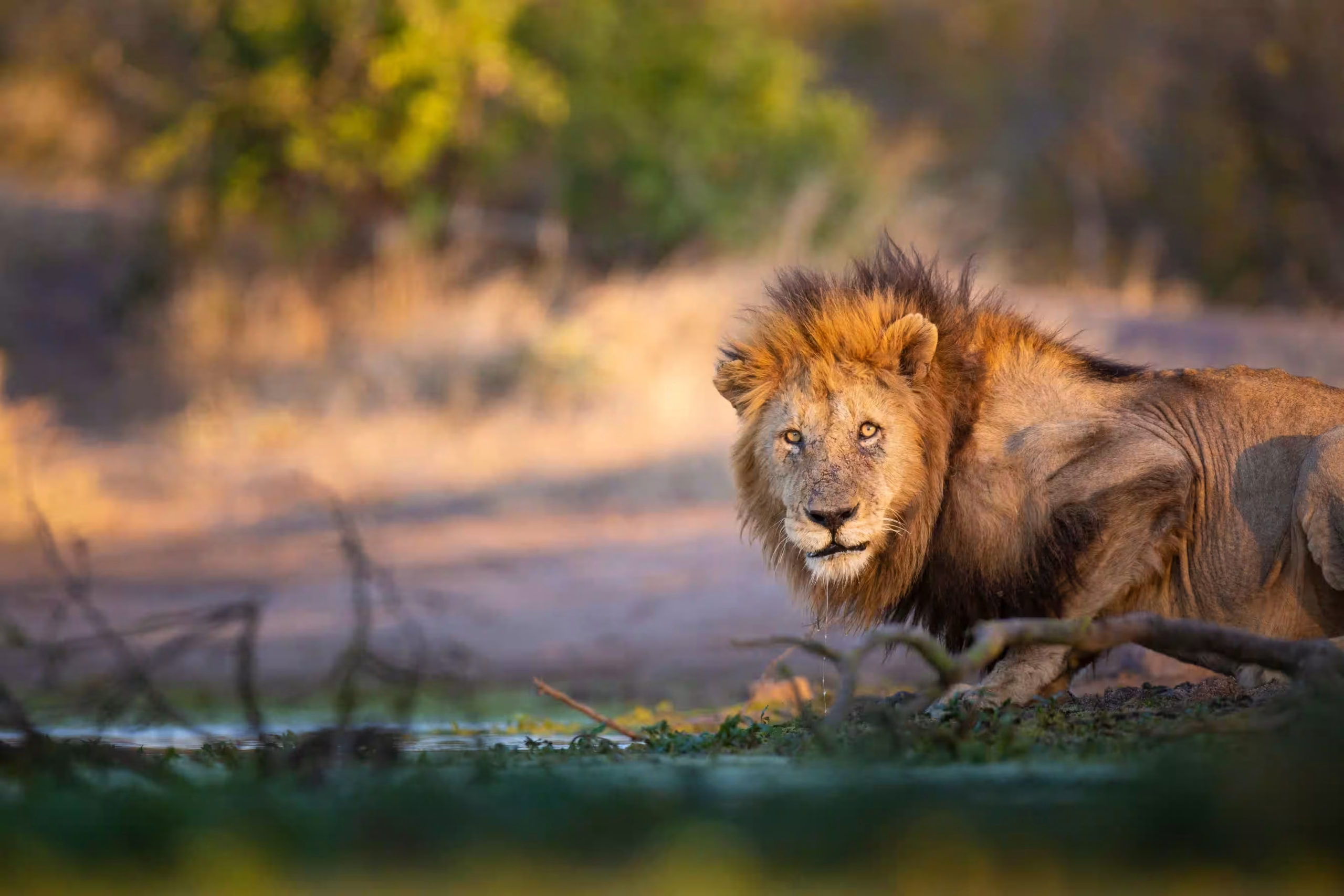
Ngorongoro is a collapsed caldera nineteen kilometres across with walls six hundred metres high, and the animals inside it largely stay — around twenty-five thousand large mammals on 260 square kilometres of floor. It is the most reliable place in Tanzania to see black rhino. There are only a few dozen and they are usually distant, so bring binoculars and manage the expectation. Lion here are habituated to vehicles to a degree that is almost uncomfortable. Buffalo, hyena in clans, and the crater’s old elephant bulls, which carry some of the heaviest ivory left in East Africa.
Lunch is at the Ngoitokitok hippo pool, inside the vehicle unless you want a kite to take the sandwich out of your hand. The floor is limited to six hours by regulation, so the day is tight and you come up the ascent road in the early afternoon. The second night on the rim means there is no packing and no drive afterwards, only the view.
Meals
Breakfast · Lunch · Dinner
Travel
600 m descent · up to six hours on the floor
Highlight
Black rhino, and the densest lion population in Africa
Dawn descent
Black rhino
Six-hour limit on the floor
Where you sleep
Pakulala Safari Camp: Tent interior detail: bed, leather safari chair and lamp
COMFORT

Pakulala Safari Camp

★★★★☆
Ngorongoro Conservation Area, rim
Second night, same room. The crater looks different on the second morning and is usually clearer.
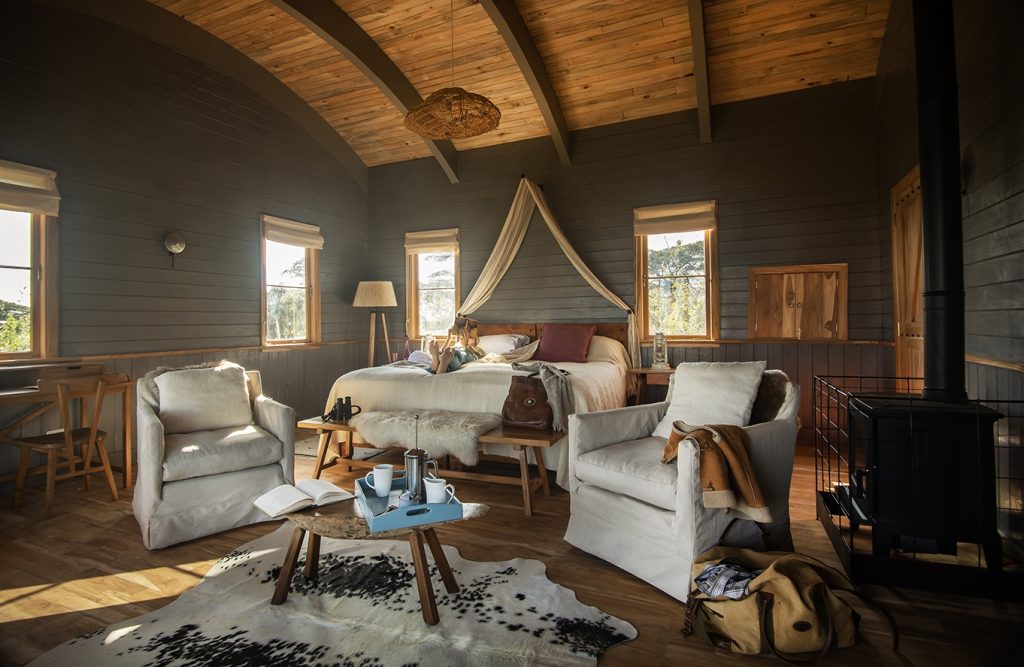
Entamanu Ngorongoro: Bedroom at main camp with canopy bed, armchairs and wood-burner
LUXURY

Entamanu Ngorongoro

★★★★★
Ngorongoro Conservation Area, rim
Second night. The afternoon is free for the first time on the trip, and the rim is a good place to do nothing.
A Maasai homestead
Down to Karatu, with Lake Eyasi as the option
03°20′S 35°40′E
Back down through the forest to Karatu after breakfast. It is a short drive and the day is deliberately loose, because the previous two have been early starts and the last day is a road. Karatu is farming country — wheat, maize and coffee on volcanic soil — and the afternoon can be a walk through the farms below the lodge, or nothing at all.
The option is Lake Eyasi. It is about fifty kilometres south-west of Karatu on a rough road, a soda lake at the foot of the Eyasi escarpment, and the Hadzabe hunter-gatherers and Datoga pastoralists live around its northern shore. A morning with the Hadzabe means leaving the rim before first light so that you arrive while they are still hunting, and it is arranged on their terms rather than ours. It makes for a long day, and we would rather tell you that than sell it as easy.
Either way you sleep in Karatu tonight, which puts you an hour closer to Arusha for tomorrow and gives you the coffee farm in the morning rather than in a hurry. If you would rather have a second morning on the crater floor than a slow day, that is the other way to use this day, and it is set out under the add-ons below.
Meals
Breakfast · Lunch · Dinner
Travel
Rim to Karatu · about 30 km · under 1 hr
Highlight
A slow day in the highlands, or a long one at Eyasi
Highland farms
Lake Eyasi optional
Hadzabe and Datoga
Where you sleep
Tloma Lodge: Standard room interior with bed, sitting area and fireplace
COMFORT

Tloma Lodge

★★★★☆
Karatu, among the coffee farms
The same farm lodge as night two, or one like it — a known kitchen and an easy start tomorrow.
Gibb's Farm: One-bedroom cottage interior: bedroom and living area with desk and garden windows
LUXURY

Gibb's Farm

★★★★★
Karatu, highland estate
An estate property with the coffee on the doorstep, so the morning walk starts from the veranda.
Flamingos in the shallows below an acacia by a lake
Coffee at the source, then the road east
03°22′S 36°41′E
The morning is the coffee. Karatu grows arabica on the slopes below the conservation area, and a farm walk takes you from the bushes through pulping, drying and roasting to a cup at the end. It takes about two hours, it is genuinely interesting even if you do not drink the stuff, and it is a gentler last morning than another game drive would be.
Then the road east: down the Rift wall past Manyara, across the Maasai steppe and back to Arusha, about 140 kilometres and three hours, with the airport another hour beyond. Lunch is on the way. If your flight is in the evening this works comfortably; if it is mid-afternoon, tell us before we book, because it changes the shape of this day and the coffee goes.
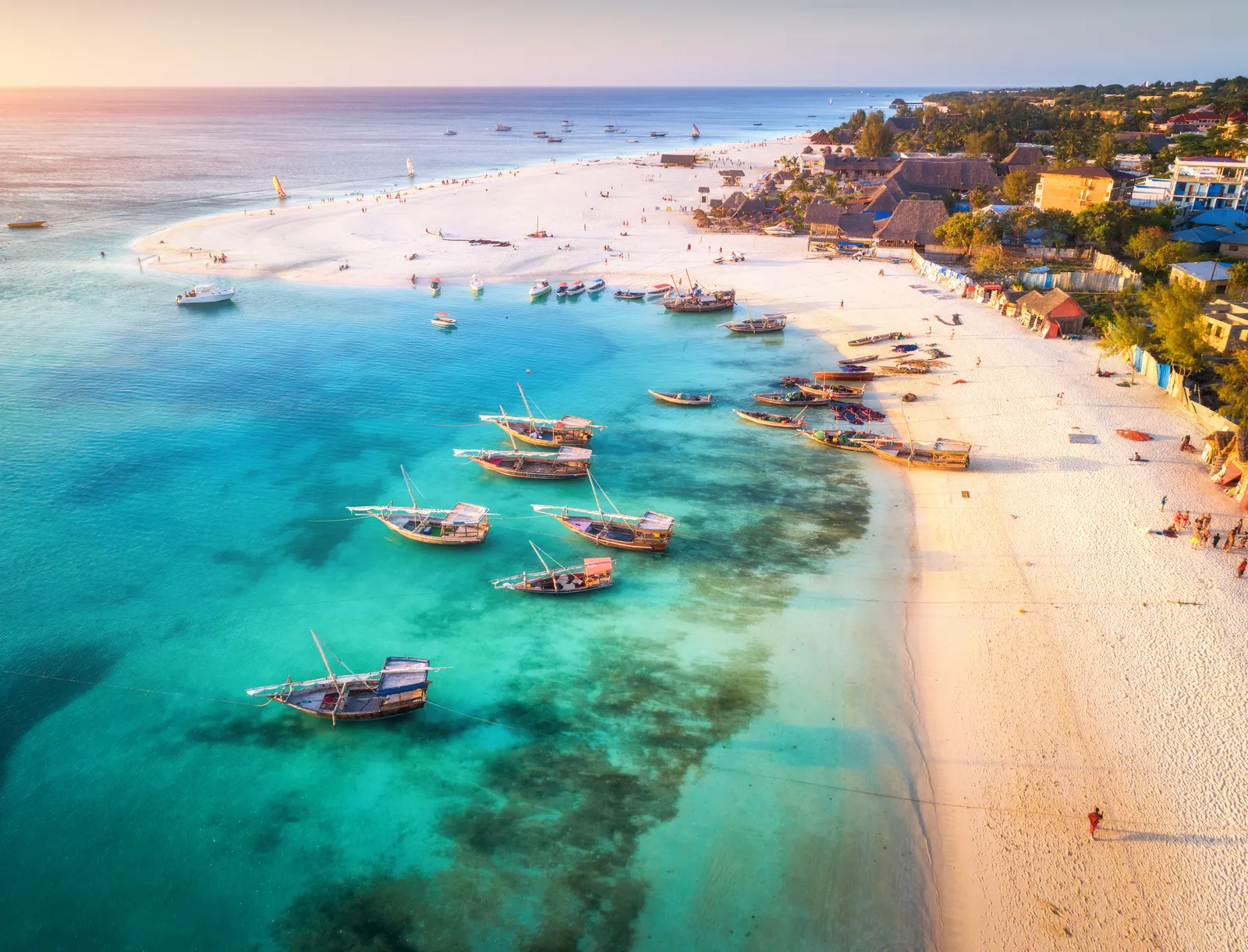
You are dropped at Kilimanjaro International, or at a hotel in Arusha if you are staying on. If you are continuing to Zanzibar, flights leave from both Arusha and Kilimanjaro and take under two hours. It is a long drive to end on, and it is the only one of the trip; that was the trade for the day on foot.
Meals
Breakfast · Lunch
Travel
Karatu to Kilimanjaro International · about 190 km · 4 hrs
Highlight
A coffee-farm morning, then Arusha or the airport
Coffee-farm walk
Rift wall descent
Airport transfer
Where you sleep
Departure day — no overnight
III · Rates

What it costs, by group size

A safari gets cheaper per person as the vehicle fills. Choose a tier to see the table.
Comfort rates by group size, per person and group total
Group sizeRoomsPer personGroup total
1 guest1 room$4,420$4,420
2 guests1 room$2,930$5,860
3 guests2 rooms$2,780$8,340
4 guests2 rooms$2,450$9,800
5 guests3 rooms$2,450$12,250
6+ guests3 rooms$2,290$13,740
Single supplement
$520
Added when a guest does not share a room
Child, 3 – 11 years
30% off
Sharing with two adults
Peak season uplift
Included in the rates above
July – October, and the festive weeks
All figures in US dollars, per person sharing unless stated. Valid for travel until 30 June 2027. Park fees, guiding, vehicle, accommodation and full board are included — see what is and is not covered below.
IV · Included

What is in the price, and what is not

Stated in full, both ways.

What is included

What is not

V · Add-ons

Worth adding, if you have the days

Priced separately and arranged on request — the Hadzabe morning and a second descent are the usual two.
A Maasai homestead
Lake Eyasi · day 5

A morning with the Hadzabe

About fifty kilometres south-west of Karatu on rough road. The Hadzabe hunt at first light, so the day starts on the rim in the dark. Arranged with the community directly and on their terms; the payment goes to them.
USD 110 per person, for 2 guests
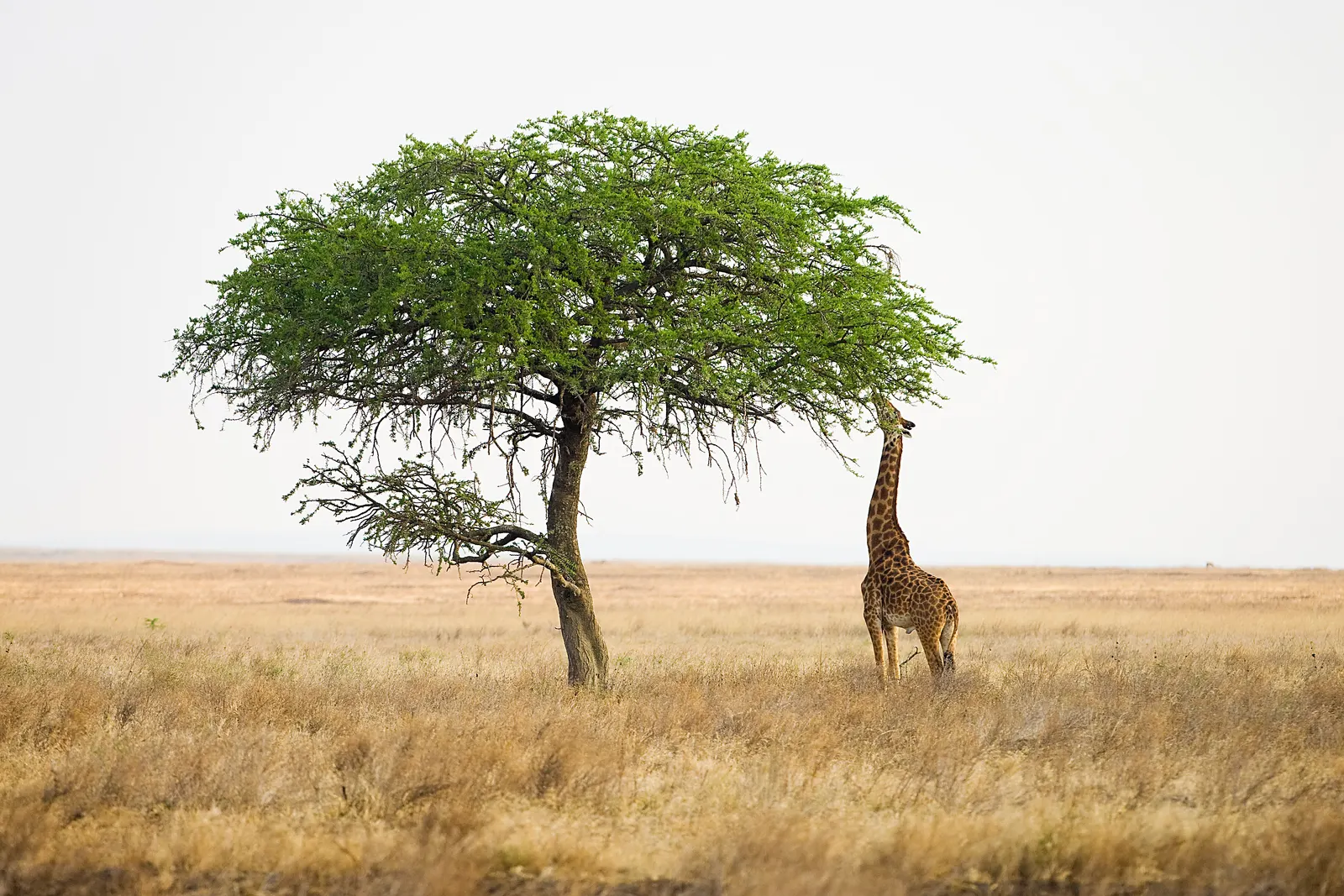
A giraffe browsing an acacia tree on the plains
Day 3 · the longer walk

Empakaai instead of Olmoti

Empakaai is the finer crater — a steep forest descent to a soda lake with flamingo on it — but it is a longer drive on rough track and a harder climb out. Swap it in if you have the legs and the weather is clear.
USD 70 per person, for 2 guests
A black rhino with buffalo on green grass
Day 5 · at dawn

A second crater descent

Come down a second morning before the drive to Karatu. The floor is different day to day, and the second descent is the one where the rhino usually cooperate. Adds a crater service fee and an early start.
USD 400 per person, for 2 guests
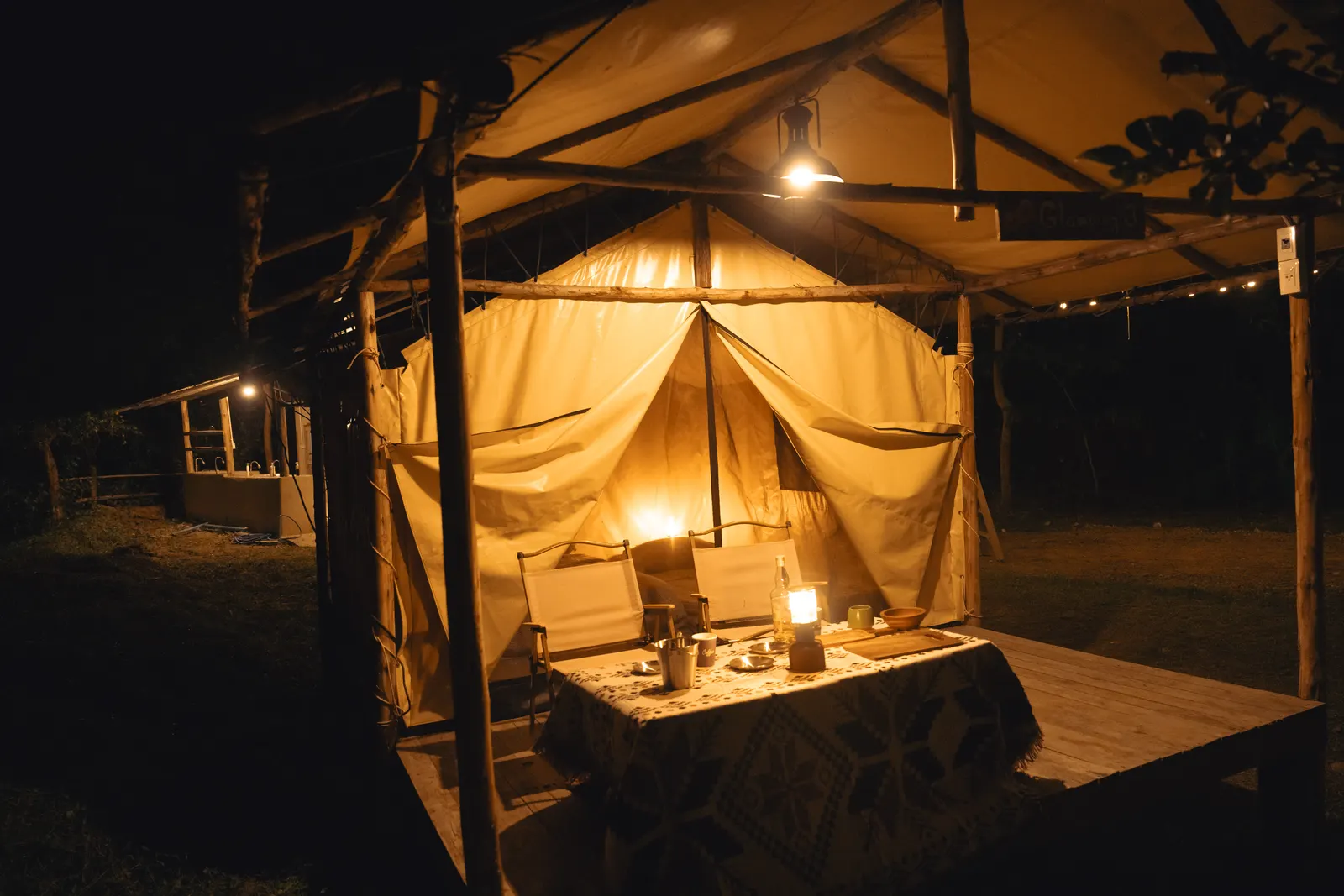
A safari tent at night
Add 2 nights · before day 2

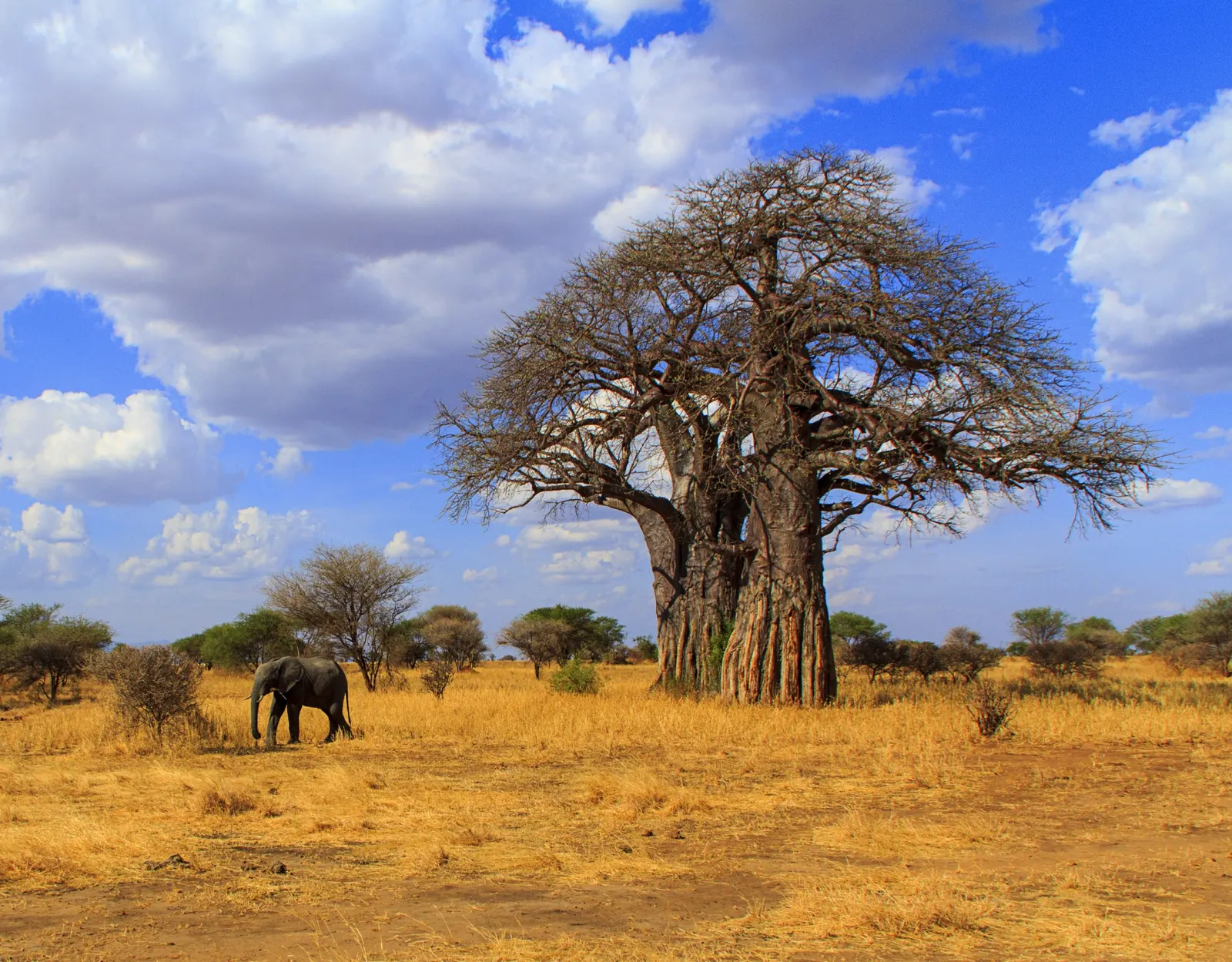
Tarangire, before you climb

Two nights in Tarangire turns this into an eight-day trip with the north’s biggest elephant herds and a night drive, which Tarangire permits and the crater does not.
USD 1,820 per person, for 2 guests
VI · The ground

Where this itinerary takes you

A lake below the Rift wall, a caldera above it, and the volcanic highlands beyond.
Flamingos in the shallows below an acacia by a lake

Lake Manyara National Park

330 square kilometres between the Rift escarpment and a soda lake, two-thirds of it water. Groundwater forest at the northern end holds elephant, blue monkey and very large baboon troops; the hippo pool is reliable, the flamingo are not. Night drives are permitted here.
Wildebeest in the Ngorongoro Crater

Ngorongoro Crater

The largest intact caldera in the world and a UNESCO World Heritage Site — nineteen kilometres across, walls six hundred metres high, around 25,000 large animals on 260 square kilometres of floor, and the most reliable black rhino in Tanzania. Vehicles have six hours on the floor.
Wildebeest in the Ngorongoro Crater

The Crater Highlands

The volcanic massif north and east of the main crater: Olmoti, Empakaai, Lolmalasin at 3,648 metres, and the Maasai grazing land between them. The conservation area allows walking with a ranger, which the national parks do not.
The question everyone asks

Will you see rhino in the crater?

~30
Black rhino on the crater floor, monitored individually
Probably, and usually at a distance. The crater holds a few dozen black rhino and they are watched closely enough that the rangers know each one, so the population is stable and the sightings are more reliable than anywhere else in Tanzania. Most mornings you will see at least one.
What we cannot promise is a close one. The rhino favour the Lerai forest edge and the open grass south of the lake, and the vehicle stays on the tracks. Descending at six matters more here than anywhere: the rhino are on the move in the first cool hour and lying up by mid-morning, when the day vehicles arrive. That is why this itinerary sleeps on the rim.
VII · Season

The best time to travel

Including the months we will tell you to avoid.
June to October is the long dry season. The highlands are clear in the mornings and cold at night — expect single figures on the rim before dawn — and the crater floor is at its most open. It is also the busiest time on the descent road, which is the strongest argument for being on it at six rather than eight.
January and February are the second window: short, green, warm, and quieter. The walking is at its best because the highland grass is fresh and the dust has gone. Manyara’s lake is usually higher, which helps the flamingo.
November brings the short rains, usually afternoon storms rather than washouts. The crater is fine in November and the rates drop. The highland tracks to Empakaai can be slow.
March to May is the long rains, and we will say plainly that this route is not at its best then. The crater still works — the animals do not leave — but the highland walks turn to mud, the rim sits in cloud for days, and the Eyasi road can close. If these are the only weeks you have, ask us and we will tell you whether to come or to wait.
VIII · Flights

Getting there and back

Fly into Kilimanjaro International. The first night in Arusha is built in.
Fly into Kilimanjaro International (JRO). It is an hour from Arusha and the airport this itinerary is built around. Nairobi and Dar es Salaam both work but both add a day and a connection.
The itinerary already includes a night in Arusha on arrival, so an evening landing is fine. If you arrive in the morning there is time for a look around Arusha before dinner, and nothing is lost.
Coming home, day 6 is a coffee-farm morning and a four-hour road to JRO. An evening departure works. An early-afternoon one means leaving Karatu at first light and losing the coffee; tell us the flight time before we book.
Tanzania requires a visa for most passports — USD 50, or USD 100 for United States citizens, valid up to 90 days. Apply online in advance rather than on arrival.
IX · Other costs

What else you will spend

Visas, insurance, tips and drinks — set out so there is no surprise on the ground.
Tanzania issues a tourist visa online (eVisa) or on arrival at Kilimanjaro. Applying in advance is faster and avoids the queue at immigration, which after an evening arrival can be long.
A yellow fever certificate is required only if you are arriving from a country where yellow fever is endemic. Coming directly from Europe or North America, it is not.
We ask every guest to travel insured. Medical cover and evacuation are the parts that matter — the nearest hospital to the crater rim is in Karatu, and anything serious goes to Arusha or by air.
Check that your policy covers walking in a protected area with a ranger; a few policies list it separately from game drives.
Tipping is customary in Tanzania and it is genuinely optional. The figures below are what guests commonly give, not what is expected of you, and no one will treat you differently for giving less.
On this route there is also the ranger who walks with you on day 3, who is tipped separately at the end of the walk. Lodge staff tips go into a shared box at reception so that housekeeping and kitchen are included.
Drinking water in the vehicle is included throughout. Everything at the lodge bar is charged to your room unless the property is explicitly all-inclusive, and most on this route are not.
Souvenirs, the coffee you will want to bring home from the farm, laundry at the lodges, and anything you forgot to pack. Cash in small US dollar notes is more useful than a card once you leave Arusha; Karatu has a bank and the rim does not.
Notes dated before 2009 are refused across Tanzania. Bring newer ones.
X · Why us

Why book this with us

01

Arusha-based, and Tanzanian-owned

We are not a booking agent forwarding you to an operator. The vehicles, the guides and the office are ours, in Arusha, which is why we can move the walk to the clear day when the rim is in cloud.
02

Two nights on the rim, not one

Almost every crater itinerary sleeps below the gate and descends behind the queue. Sleeping on the rim twice buys the first hour on the floor and a whole day in the highlands nobody else has time for.
03

We will not sell you the Serengeti in six days

It is 330 kilometres from Karatu to Seronera. On a six-day trip that is two nights spent getting there and back. This route leaves it out and spends the time on foot instead.
04

Cultural visits on the community's terms

The boma and the Eyasi morning are arranged with the households and the payment goes to them. We tell you the amount before you go, and you are not asked for more on the day.
XI · Questions

Frequently asked

What guests ask before booking a crater trip.
The rate depends on your group size and which accommodation tier you choose, and it moves with the season. The table above sets out the per-person price for every group size from one to six. Our rates for this itinerary are set out in the table above — ask us and we will quote for your exact dates rather than give you a range.
Because six days cannot reach it honestly. Seronera is about 330 kilometres west of Karatu and five to six hours each way, so adding it would cost two of the five nights and the highland day. If you have eight days or more, the seven-day northern circuit or the eight-day version includes the Serengeti properly.
Olmoti is about an hour up through forest on a clear path and less coming down, at around 3,000 metres, so you will feel the altitude more than the gradient. Empakaai is steeper — thirty to forty-five minutes down to the lake and an hour or more back up. Both are walked with an armed ranger. Anyone who walks comfortably for two hours can do Olmoti; Empakaai needs reasonable fitness.
Yes. A second descent on the morning of day 5, before the drive down to Karatu, is the most common change to this route. Each descent carries a crater service fee and is limited to six hours on the floor. The price of the second descent is about USD 400 per person for two sharing.
It is one of the better ones for them: short drives, one road day, and a walk. The ranger-led walks are normally for ages 16 and over on safety grounds, so with younger children we shape day 3 around the boma and a rim viewpoint instead. Some lodges set their own minimum ages. Child rates are 30% below the adult rate for children sharing with two adults.
June to October for clear highland mornings and a dry crater floor, or January and February for green walking country and fewer vehicles. November is quiet and good value. We do not recommend March to May for this route because the walks turn to mud and the rim sits in cloud.
Cold. The rim is at 2,300 metres and in the dry season the temperature before dawn is often in single figures Celsius, with a wind off the crater. A fleece, a warm hat and a windproof layer are not optional for the six o’clock descent. The lodges have fires and blankets; the open-roofed vehicle does not.
In Lake Manyara, yes — it is one of the parks licensed for them, and one can be added on day 2 at about USD 180 per person. Not in the Ngorongoro Conservation Area; the crater closes to vehicles in the late afternoon and there are no night drives on the rim.
Yes. This is a private safari and the route is a starting point. Swapping Olmoti for Empakaai, adding a second descent, adding Tarangire at the front or Zanzibar at the end are all normal requests.
XII · Your trip

Request your personalised safari proposal

Tell us how you like to travel and we will put together a personalised proposal for this route — dates, camps and a firm price per person. No payment is required at this stage.

No payment is required at this stage. We reply by email and WhatsApp within one working day.

Ngorongoro, and the Crater Highlands

6
Days
5
Nights
2
Parks
2,300 m
Rim
Starts
Arusha, Tanzania
Ends
Arusha, Tanzania
Departures
Daily — a private safari on the dates you choose
Availability
Open all year, subject to lodge space
From
from$2,290/pp
Per person, sharing
Private safari · no booking fee · we reply within one working day
from $2,290 / person
Loading itinerary…
Saved Trips